SCRAM: An Investigation
PIRE is currently conducting studies on the reliability of available transdermal alcohol sensors. Apparently the results are just examples not conclusions until the ever so trustworthy NHTSA reviews them. Their findings thus far include some theories that I had not yet encountered, such as the original tests claim :
Case Study 1. Elevated TAC Reading
On 12/30/2002, the SCRAM Network generated an Alcohol Detected alert for Client 1. This
alert is severe in nature and should be analyzed immediately.
An Alcohol Detected alert is generated when the SCRAM bracelet detects ethanol over the
typical agency standard of .02%. An interferant can also cause elevated TAC readings. By
analyzing the alert, a real drinking event can quickly be differentiated from an alert that is
caused by use of a banned substance or an environmental factor.
PIRE has found that Detection algorithm is good not perfect – it can
misclassify rapid rise in BAC as an external interferent.
An example of a false-negative, however this device is spot-on accurate remember! A good look at A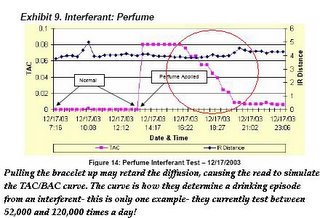 MS's perfume test shows a fast paced decline in which they claim differen- tiated the interferent from a drinking episode, but pulling the bracelet up tight could retard diffusion and create the curve. Had they not known the environmental factors I am confident they would have prosecuted on the curve. This is only one example, there are thousands of tests per day in a non-controlled environment.
Here are some of PIRE's findings thus far:
• Minor problems included:
– SCRAM: some bouncing on ankle while exercising
– SCRAM: minor delays at airport security (5-7 min)
– SCRAM: minor bruising two female subjects
– WrisTAS: raising rash on skin surface
– WrisTAS: pads get stinky after a week
– WrisTAS: must remove for showering
Some SCRAM-related issues:
• Data may get spiky at times – probably water
accumulating in the sensor – accuracy suffers
• If water is present, sensor may lose ability to detect
ethanol or have delayed sensitivity – with a recent
design change this may now be better
• Paced drinking with food may not trigger an "alert"
• Detection algorithm is good not perfect – it can
misclassify rapid rise in BAC as an external interferent –
their algorithm tries to protect against false positives
• Modem communications usually work well, but they do
not work with mobile phones – this will be problem if no
landline available to offender.
• A few landlines had trouble dialing out.
Conditions of the skin also distort readings, and the accumulation of water in the bracelet ( if the reads are spikey, unknown environmental factors may play a role-RFI) brings me back to my original hypothesis of erroneous obstruction reads. This aspect of the device works like this:
As the IR sensor shines an infrared beam against the client’s skin, the skin absorbs a certain
amount of the signal. The rest of the signal is reflected back to a receiver in the SCRAM
bracelet. The receiver measures the amount of signal that was reflected, and converts that
signal to a voltage. Initially, the voltage is used to establish the amount of signal that is
typically reflected off of that particular client’s skin. Subsequent signals are compared against
this initial signal. If the subject inserts a foreign object between the SCRAM bracelet and the
skin, the strength of the reflected infrared signal changes. If the subject removes the SCRAM
bracelet, the SCRAM bracelet detects the absence of an infrared signal, and generates a
Potential Removal alert.
Hypothesis: Dehydration, dry skin, or water trapped in the bracelet (sensor) may alter the amount of the signal absorbed by the skin, thus therefore resulting in an erroneous read. Also, it may only take a small portion of the sock under the corner of the bracelet to move the sensor and register as obstruction, with no way to prove this was the case they would believe it was intentional.
AMS reports the IR distance differential for different types of obstructants in volts:
Client 1) Normal = 3.58 - 4.11
Black trash bag = 3.05 - 3.12
difference -.53 - .99 (assuming the guage is difficult,these are examples of the sensitivity)
Client 2) Normal = 4.16 - 4.29
Saran wrap = 4.29 - 4.87
difference +.13 - .56 volts
Client 3) Normal = 3.55 - 4.02
Thick Sock = 5.00 - 5.00
difference +1.45 - .98 volts
These experiments were conducted in alliance with the consumption of alcohol, and in all of these cases, although the TAC/BAC correlation was distorted, there was an indication of consumption. Unfortunately the sock was the most effective interference, the common everyday apparel. Client 3 shows a thick sock has a dramatic effect on the read, a guage which exceeded this devices measuring ability, leaving me with the conclusion that the top of the sock so much as in the corner of the bracelet can produce an erroneous read, and pant legs, blankets, etc...
With 2,200 people wearing SCRAM tested twice an hour, that is 105,600 tests daily so the importance of reliability is overwhelming. If SCRAM were 99.9% effective this would mean that today there were over 100 false positive/negative reads. Their claim is that it tests for alcohol twice an hour, so this may not include the obstruction tests. As a result of the saran wrap test they quote," The abrupt and sustained peaking of the IR Distance Voltage readings proves that
the subject used an obstruction to mask the presence of alcohol." According to the sock test and my experience this proves nothing, it gives reasonable suspicion, probable cause and is a cause for action (not enough for conviction), making it necessary to find corroborating evidence such as urinalysis, PBT, even a paper trail. The alcohol could be from the spouse spraying disinfectant and the vulnerability of the exposed bracelet from a sock just convicted the innocent!
REFERENCE:
http://www.nlectc.org/training/commcorr2005/marques_comcorr2005_transdermal.pdf
http://j.b5z.net/i/u/2099113/i/TamperDetectionWhitePaper.pdf
Lasley, 20, signed up for the anklet because he hopes a Durham judge will give him a lighter sentence this month on a charge of drunken driving _ he faces a year in prison...The anklet is also sensitive to any alcohol that comes in contact with the skin. For example, Lasley's anklet registered when he put on a shirt washed in a detergent that contained alcohol. http://www.statesville.com/servlet/Satellite?pagename=SRL%2FMGArticle%2FWSJ_BasicArticle&c=MGArticle&cid=1031783999368&path=!statenews
HOME
Case Study 1. Elevated TAC Reading
On 12/30/2002, the SCRAM Network generated an Alcohol Detected alert for Client 1. This
alert is severe in nature and should be analyzed immediately.
An Alcohol Detected alert is generated when the SCRAM bracelet detects ethanol over the
typical agency standard of .02%. An interferant can also cause elevated TAC readings. By
analyzing the alert, a real drinking event can quickly be differentiated from an alert that is
caused by use of a banned substance or an environmental factor.
PIRE has found that Detection algorithm is good not perfect – it can
misclassify rapid rise in BAC as an external interferent.
An example of a false-negative, however this device is spot-on accurate remember! A good look at A
 MS's perfume test shows a fast paced decline in which they claim differen- tiated the interferent from a drinking episode, but pulling the bracelet up tight could retard diffusion and create the curve. Had they not known the environmental factors I am confident they would have prosecuted on the curve. This is only one example, there are thousands of tests per day in a non-controlled environment.
Here are some of PIRE's findings thus far:
• Minor problems included:
– SCRAM: some bouncing on ankle while exercising
– SCRAM: minor delays at airport security (5-7 min)
– SCRAM: minor bruising two female subjects
– WrisTAS: raising rash on skin surface
– WrisTAS: pads get stinky after a week
– WrisTAS: must remove for showering
Some SCRAM-related issues:
• Data may get spiky at times – probably water
accumulating in the sensor – accuracy suffers
• If water is present, sensor may lose ability to detect
ethanol or have delayed sensitivity – with a recent
design change this may now be better
• Paced drinking with food may not trigger an "alert"
• Detection algorithm is good not perfect – it can
misclassify rapid rise in BAC as an external interferent –
their algorithm tries to protect against false positives
• Modem communications usually work well, but they do
not work with mobile phones – this will be problem if no
landline available to offender.
• A few landlines had trouble dialing out.
Conditions of the skin also distort readings, and the accumulation of water in the bracelet ( if the reads are spikey, unknown environmental factors may play a role-RFI) brings me back to my original hypothesis of erroneous obstruction reads. This aspect of the device works like this:
As the IR sensor shines an infrared beam against the client’s skin, the skin absorbs a certain
amount of the signal. The rest of the signal is reflected back to a receiver in the SCRAM
bracelet. The receiver measures the amount of signal that was reflected, and converts that
signal to a voltage. Initially, the voltage is used to establish the amount of signal that is
typically reflected off of that particular client’s skin. Subsequent signals are compared against
this initial signal. If the subject inserts a foreign object between the SCRAM bracelet and the
skin, the strength of the reflected infrared signal changes. If the subject removes the SCRAM
bracelet, the SCRAM bracelet detects the absence of an infrared signal, and generates a
Potential Removal alert.
Hypothesis: Dehydration, dry skin, or water trapped in the bracelet (sensor) may alter the amount of the signal absorbed by the skin, thus therefore resulting in an erroneous read. Also, it may only take a small portion of the sock under the corner of the bracelet to move the sensor and register as obstruction, with no way to prove this was the case they would believe it was intentional.
AMS reports the IR distance differential for different types of obstructants in volts:
Client 1) Normal = 3.58 - 4.11
Black trash bag = 3.05 - 3.12
difference -.53 - .99 (assuming the guage is difficult,these are examples of the sensitivity)
Client 2) Normal = 4.16 - 4.29
Saran wrap = 4.29 - 4.87
difference +.13 - .56 volts
Client 3) Normal = 3.55 - 4.02
Thick Sock = 5.00 - 5.00
difference +1.45 - .98 volts
These experiments were conducted in alliance with the consumption of alcohol, and in all of these cases, although the TAC/BAC correlation was distorted, there was an indication of consumption. Unfortunately the sock was the most effective interference, the common everyday apparel. Client 3 shows a thick sock has a dramatic effect on the read, a guage which exceeded this devices measuring ability, leaving me with the conclusion that the top of the sock so much as in the corner of the bracelet can produce an erroneous read, and pant legs, blankets, etc...
With 2,200 people wearing SCRAM tested twice an hour, that is 105,600 tests daily so the importance of reliability is overwhelming. If SCRAM were 99.9% effective this would mean that today there were over 100 false positive/negative reads. Their claim is that it tests for alcohol twice an hour, so this may not include the obstruction tests. As a result of the saran wrap test they quote," The abrupt and sustained peaking of the IR Distance Voltage readings proves that
the subject used an obstruction to mask the presence of alcohol." According to the sock test and my experience this proves nothing, it gives reasonable suspicion, probable cause and is a cause for action (not enough for conviction), making it necessary to find corroborating evidence such as urinalysis, PBT, even a paper trail. The alcohol could be from the spouse spraying disinfectant and the vulnerability of the exposed bracelet from a sock just convicted the innocent!
REFERENCE:
http://www.nlectc.org/training/commcorr2005/marques_comcorr2005_transdermal.pdf
http://j.b5z.net/i/u/2099113/i/TamperDetectionWhitePaper.pdf
Lasley, 20, signed up for the anklet because he hopes a Durham judge will give him a lighter sentence this month on a charge of drunken driving _ he faces a year in prison...The anklet is also sensitive to any alcohol that comes in contact with the skin. For example, Lasley's anklet registered when he put on a shirt washed in a detergent that contained alcohol. http://www.statesville.com/servlet/Satellite?pagename=SRL%2FMGArticle%2FWSJ_BasicArticle&c=MGArticle&cid=1031783999368&path=!statenews
HOME
posted by marcellus91872 at 12:59 AM


31 Comments:
A shirt washed in detergent that contained alcohol? That puts my mind at ease. I am hours away from meeting with officials because of a "confirmed consumption" reading. This reading was in the middle of my work day, while I was with patients in a dental clinic. When officials tried to have me sign a form stating that I would "not posses, use, or come in contact with any substance containing alcohol" I laughed. Do they want me to spread infectious diseases to my patients? I refused and have been in contact with the official monitoring my case. She had readings throughout the duration of the scram's application, but none were "confirmed consumption". I am very angered because of these happenings, as I have been sober for 5 months.
hOW MUCH DOES A WRISTAS Cost ?
I just had my "bracelet" read and got some "numbers" registered. I had some balsamic vinegar on my salad at the time that it showed some activity and ate some chocolate at the other time that activity was registered. What the hell is up with that?? So then they made me pee and blow. Any input on this would be appreciated.
I have yet to see Wristas marketed, probably external influence would be harder to avoid considering the location it is worn.
As far as the reads, I don't know the numbers or burn-off so it is impossible to discuss possibilities. More than likely an external source, laundry detergent was the alledged contaminent in one read. I only eat balsamic vinegar and oil on my salad and did not register due to the consumption of any food, it is possible however, endogenous does happen.
Marcellus
My brother just got a call from his PO stating that the report she received, showed some kind of obstruction was made to the bracelet and that the report showed no activity between the hours of 9:15 p.m. to 5:27 a.m. in the morning. Has anyone ever had a NO reading? I mean how can one prove that they were sleeping at the time? Absolutely no drinking or intentions where made to obstruct the bracelet, yet my brother might go to prison.
Hey all,
I am on the SCRAM here in Michigan, I have not drank any alcohol since I was put on probation a yr ago. I have been wearing the SCRAM for 7 months, and in this time it has had false readings of alcohol consumption. The last 3 being in the past 2 weeks. I am at a loss because my PO is looking to violate me. One reading was .032. That was the first being in the middle of May. I have not drank any alcohol, yet it comes up with a positive. The past one was yesterday, last night and today. Reading alcohol up to .08. I even blew into the pbt and came up with .000, yet my PO says the SCRAM does not lie. I know POs don't give any credibility to the people on probation, however, I have found myself going to the police station and paying to blow for an alcohol test to give me something else to prove I am not drinking. I went Monday night and blew .000 but the scram was reading alcohol, but my PO would not tell me what the reading was. He seemed annoyed that I am going to the Police station and blowing and told me that the SCRAM will hold up in court against a PBT, is this true???? This morning I went to the POs office to have the SCRAM checked out, it showed alcohol all the way throughout the night. I had the PBT from the police station and I even had to blow at the POs office, again I blew .000, but the SCRAM was detecting alcohol. I am at a loss as to what to do. He did not change out the SCRAM, he just told me he would be in touch. WTF. I know this much about myself to say that if I am going to drink, I will be on a 4 day binge and the SCRAM will be reading 4 digits as well. I am not going to risk my freedom over a beer. I am charged with beating hell out of 2 guys, one a reserve cop, (just my luck). Prosecutor said I didn't fight fair, and here I am. I don't mess around with drugs, and if I did drink, I would say so. My word is worth more to me than being caught in a lie. WHAT RECOURSE DO I HAVE WHEN I BELIEVE THE SCRAM IS EITHER FAULTY, OR SOMEONE IS PLAYING WITH THE COMPUTER.
Scram only reads up to .08, after that it is a mystery, was it .999, noone knows! Get a lawyer who is familiar, get the officers to testify, during cross examination drill the P.O. if you seemed intoxicated, had the scent of alcohol etc... & hope your judge has more integrity than the P.O.
Keep getting evidence that you are not drinking (I never had that chance) and you may get a law suit out of it. He is taking PBT's, face to face, he'll get his!
Scram only reads up to .08, after that it is a mystery, was it .999, noone knows! Get a lawyer who is familiar, get the officers to testify, during cross examination drill the P.O. if you seemed intoxicated, had the scent of alcohol etc... & hope your judge has more integrity than the P.O.
Keep getting evidence that you are not drinking (I never had that chance) and you may get a law suit out of it. He is taking PBT's, face to face, he'll get his!
Today I saw a woman get sanctioned and thrown into jail for the weekend for having a "tampered" issue. She had an obstruction during night hours. She may or may have not been guilty. There is no way of knowing. If just one row of the sensor area is blocked- it comes up obstructed! That could be a sock or a blanket in the night. This system is ridiculous and appauling. It is sickening to see another part of our american system is flawed and unjust.
Husband has the SCRAM unit. PO called, "confirmed consumption and tamper" during middle of day while he was at work. Auto Mechanic...around all "bad" glycols and everything with alcohol. Did not drink...now back to court we go...PO says they know the difference between ingested and environmental factors? What about the battery vs voltage? What do we do now?
I beat confirmed consumption with credible witnesses (the 2 business owners I worked for that day), physiologists will kick a P.O.'s zealous fanny in court! I lost $12,000 because this contraption and could have beat it had I the knowledge I have now, it is all here in print. RFI, endogenous, possible reasons for the extended diffusion of ethanol such as water accumulation in the bracelet if it is old most likely scenerio etc...
hey marcellus 91872 i have a legal question maybe you could help me with , please respond if you check this site anymore....
of course I'm still here, they are not using the device constitutionally yet!
marcellus91872@netzero.net
Marcellus, please contact me at r_shackleford2012@yahoo.com, I too have received the demon bracelet and have lots of concerns:) Thanks in advance!
I was recently straped with an alcohol bracelet after having a few drinks with neighbors in my back yard while on probation. My bad and I admitted to that. I was called and told that three days later I was shown as drinking at 6:00 PM on SuperBowl Sunday. I was not. I also have several friends that were around me at that time that saw me drinking water and Red Bull (Directly from an unopened can or bottle). This seems so unfair I can't believe this is happening. I went as far as asking my wife this morning if there was any way alcohol could have been in my system. Being on probation nobody is going to believe what I'm saying. I get that. I absolutely did not consume alcohol and have not since the evvening noted above. How can I prove this?
I was recently straped with an alcohol bracelet after having a few drinks with neighbors in my back yard while on probation. My bad and I admitted to that. I was called and told that three days later I was shown as drinking at 6:00 PM on SuperBowl Sunday. I was not. I also have several friends that were around me at that time that saw me drinking water and Red Bull (Directly from an unopened can or bottle). This seems so unfair I can't believe this is happening. I went as far as asking my wife this morning if there was any way alcohol could have been in my system. Being on probation nobody is going to believe what I'm saying. I get that. I absolutely did not consume alcohol and have not since the evvening noted above. How can I prove this?
One cannot prove their innocence, challenge the imputer. In most states these devices do not meet the standards of Daubert. A physiologist is a weapon I've seen beat the beast, however costly. Environmental exposure seems to be quiye common still, the read will maintain a constant for hours. One thing I have yet to see, my read out sheet only went up to .08, how do we not know my level surpassed the lethal limit?
I confronted the testing company immediately and they are animate that it was a drinking event due to the rise and gradual fall of the readings matching that of consumed alcohol. Marcellus is there any information you have that might help me regarding the lack of reliability in these things? Everyone says just write this off and make sure it doesn't happen again. I can't be comfortable leaving it up to this bracelet not to malfunction again. There has to be a reasonable explanation other than telling me I drank that evening. I'm not crazy and I know what I did or did not do.
My husband was supposed to be getting the SCRAM bracelet removed on Wednesday. He went in this past Friday to download and see his PO and was told that he was going to jail because he had a "confirmed consumption" from Monday!!! They said that it showed he was drinking from 1:00am Monday morning till 2:00pm Monday afternoon. He has been in jail since Friday and when I called his PO to find out how long he would be in jail she told me she did not know that the committee would be meeting on Monday and she would have more info then. We went to bed at 12:00 and he went to work on Monday!!! I know he didn't drink!!! He has spent the entire weekend in jail for something he didn't do and I am furious about this injustice!! PLEASE, PLEASE any info or help with this would be much appreciated!!! He has dome everything they have told him to do!! He has gone by the book!! We have a family and this is putting everything in jeopardy! He is the sole provider in our family!! I know he is innocent!!!!
I truly feel for you. This is what I am afraid of. They are so convinced they are right that we seem to have no chance. It actually had me thinking that maybe I did drink and just didn't realize it. That's why I asked my wife to make sure. I never doubt myself and that's what this has me doing. I know I didn't drink adn so does everyone else that was at teh Superbowl party. I made a point of making it clear so nobody would even offer me a drink. I live in AZ. Where are you? I hope your husband gets out Monday. How strict are they where you are?
Hi Nannas dad!! We live in Georgia. Thank you for responding to my post, it is nice to have someone to talk to about the frustration I and my husband are going through right now. He makes cleaning chemicals for restaurants and made them aware of this before hand and they said that shouldn't be a problem but they would address it if it came up. When I talked to his PO, I reminded her of this and she told me that this was different and was a "confirmed consumption". She also asked him if it was possible that he slept walked and drank?!? I mean really?!? Not possible because we have no alcohol in our house!!!! I am just really disappointed in our judicial system!!!! I thought we as american's were "innocent till proven guilty"!! I am on pins and needles about the committee meeting tomorrow! All I can hope and pray is that someone on this committee has common sense and will let my husband come home!! I hope all goes well with you, your family and what you all are dealing with!!
Nannas dad: They said the same thing to me and threatened me yet I beat them in court, it was an obstruction that started me on this journey. Fact is, you have to see the read which a lawyer (and physioliogist) can get. I would never be comfortable putting my livelihood and liberty in their hands. Let me guess, you received a letter stating "you are being afforded a hearing to prove why you should not be held in contempt of court", doesn't sound like people with an interest in justice! Witnesses was all I needed, I was at work all day and was not afforded an opportunity to admit all my evidence before being granted benefit of the doubt. The machine probably didn't malfunction, the humans reading it malfunction, chances are with some form of alcohol in nearly everything we use (these things are non-specific, they even pick up yeast) its a legit read. Make sure your lawyer knows of this:
http://www.michbar.org/journal/pdf/pdf4article1014.pdf
Crystal: Very typical, 13 hours is the norm for erroneous reads, if he was at work and the read is elevated, witnesses at work should clear him. I'd like to see a malicious prosecution case against them, I'd like to take the stand in that one!
Crystal - Good Luck today
Marcellus - Thanks for the reply.
I'll respond better when I get back from work.
Well, here it is Tuesday night and my husband is still in jail!! I realized today that I have been given the run around since Friday. This morning I called his PO and of course I had to leave a message and have still not heard from her!! I called the lady at the courthouse who we initially saw to get everything set up for the program and she gave me the name and # of the DA who she said is the person I would need to talk to. So, I called and was told that he was in court all day but he was aware of my husband, what was going on and would be meeting with my husband today if he hadn't already. She took my name and # and said she would have him call me to let me know what was going on. At 5:00 I receive a phone call from him and he says to me "what's going on with your husband?" which I replied "I was told you would be seeing him today and you were the person I needed to talk to to find put when my husband was going to be released." He told me that was incorrect that he had no idea he was suppose to meet with my husband and he usually charges $300.00 to take care of stuff like this. I asked him what my husband had to do to get put of jail and he tells me all he has to do is write a letter to the judge accepting the sanctions, serve 48 hrs (which would have been yesterday mind you) and he would be free to go. He told me that if he requested a hearing claiming he did not drink that my husband would remain in jail until his hearing. I am FURIOUS!!!!! His PO could have told me this Friday but instead she said the comitte would be meeting today which I don't think happened. Plus I was informed that it didn'tatter that he was at work from 8:00 am till 5:00 pm and it didn't matter if there was witnesses that would vouch for him because the read out from "the SCRAM" said a confirmed consumption. His PO also told him that they can tell if it was an environmental or if he actually drank!! All of the research I have done tells me that they are liars and full of crap!! Any input would be greatly appreciated!! I am at my wits end and so is my husband!! We have rent to pay and with him as our sole provider and stick in jail for something he didn't do things are falling apart!!
You need an attorney, of corse its confirmed consumption, the judge will make the assessment. They did the same to me, still went to court and won.
Crystal - Have you been able to get this handled? You can contact me at kevin@kbuildsit.com.
Wow this is amazing. Thought I was only one going through this. I was called by PO and told that I had a confirmed consumption with 10 days before Scram was suppose to be removed. Scram had been on for 2 months already. This supposidly happened on 26december. Not only would I not drink with such little time to have it removed, but it was after Christmas and before my Birthday which is 31December. Common sense would say if I were going to during during the Holidays it would be one of those days. The one thing I do know with god as my witness, on my kids life and mothers grave is that I DID NOT CONSUME any ALCOHOL. They brought me in on 29D December for UA and that was negative. The UA is suppose to detect Alcohol use within a 3 day window so if they follow their own rules then this should be proof that I didn't. I also offered to take a polygraph test and pay for it to prove my innocence. I'm willing to do whatever I can to prove myself. I asked court to give me something that I can prove that I wasn't drinking in the future and they removed Scram and gave me Soberlink. Soberling is just like a breathalizer. At least with Soberlink it will tell you if you fail right then and allow you to retest. This also give you time to go down and do UA or use another breathalizer to at least prove you didn't drink. With Scram you get the alert too late at times and it doesn't give you time to get another test to prove your Innocence. Some info I found on internet suggest that the PO should immediately followup with UA to assist the Scram due to unreliability. I've prayed for all of us that had false positive and didn't drink.
How CA Physiologist help
How CA Physiologist help
Yeast does effect the scram...a rep from RMOMS told me they had a client who worked at subway, and they had to reMove the device because of the yeast in the air from the bread baking.
I haven't gotten any negative readings but reading all of these comments has me terrified. I've got a SCRAM on now and I almost consumed vinegar. Ugh. I honestly need a list of things not to consume
Post a Comment
<< Home