Friday, March 13, 2009

SCRAM: In The Name of Justice

As I continue to get reports of false-positive, and wearers contact me in distress trying to figure out how to prove their innocents, it is nice to see AMS has constructively solved the problems! The device works, but there is only one way to read the report constructively, that's in compliance with the Constitution.

"Has "Big Brother" gone too far?

Updated: March 12, 2009 02:51 AM

Instead of going to jail, a high-tech bracelet gives some a second chance to prove themselves, keep their jobs and stay with their families.

But as Contact 13 Chief Investigator Darcy spears reports, some say it's a dangerous device that's putting innocent people in jail.

In the beginning, Ken Cooper thought, "this can't be happening."

The twice-convicted D-U-I offender isn't here to make excuses for himself.

"Definitely made some mistakes."

He's been to jail and he's served his time.

For part of his sentence, the court ordered him to wear a secure continuous remote alcohol monitoring device called SCRAM.

But Cooper and many others say SCRAM is a scam.

"In the beginning I thought, I'm just gonna go with the program and hope for the best. And right off the bat I had nothing but problems. It wasn't reading right. I had to go into their office. They had to use this magnetizing thing on it a few times."

The SCRAM device is worn on the bare leg just above the ankle.

It can tell if you've been drinking by measuring the alcohol that comes out your pores.

You can't take it off and it keeps tabs on you 24/7.

When Ken had it on, court documents show it kept reporting he was drinking again, even though he was ordered not to.

This time, he says he knew he was innocent.

"I can see how maybe the positive readings came, I mean, I work in a place where there's a lot of alcohol. But they assured me that there's no way that a spill or this or that can cause the monitor to go off."

The SCRAM manufacturer admits the device can't be worn by people who work at ethanol fuel plants, by diabetics, and there's even a list of items to avoid because they contain alcohol.

SCRAM can detect everything from deodorant and hair spray to household cleaners, cologne, perfume, lotions, gasoline, and mouthwash.

At Ken Cooper's job, he was surrounded by most of that, and lots of alcohol too.

At the time, he worked at Tao nightclub and Tao beach inside the Venetian.

"I ended up losing my job."

After he ended up in jail.

"Before I could even say anything I'm in handcuffs and like, words can't even describe. I was just in awe," Cooper recounts from a court hearing last Spring.

Court documents detail what his SCRAM device was reporting.

Repeated drinking events--all at times when he says he was at work.

"I've made mistakes but I was following the rules."

For non-compliance with SCRAM, Henderson Judge Mark Stevens sentenced Cooper to 17 days in jail.

"It was the toughest 17 days ever."

Soon after he got out, SCRAM reported a new violation.

Cooper and his attorney, Scott Holper, had had enough.

"We conducted a lot of research which indicated that this device was creating false positives," Holper says.

Internet bloggers say "The product is putting a lot of honest people in jail."

"The company and the court is playing Russian roulette with someone's life."

And "Chances are you will go to jail - even if you are not guilty! So much for justice..."

In Ken Cooper's case, his attorney says SCRAM did some research.

"They performed a study in which it was determined that the alcohol was airborne," says Holper.

And the same judge who threw Cooper in jail for the first set of violations ordered the SCRAM device taken off his leg, "in the interest of justice."

"So our concern, and the reason why we are filing a lawsuit against SCRAM and the City of Henderson, is to prevent individuals from being incarcerated for actions that they did not commit," Holper explains.

Because of that pending lawsuit, neither SCRAM nor the City of Henderson would go on camera.

A City spokesperson told Contact 13 there were some concerns that the device may have been giving incorrect readings in Ken Cooper's case.

And a SCRAM rep said there are a handful of situations that come up with a red flag where they will ask the court to rescind the device.

SCRAM says its rate of false positives is better than most other testing methods at one per 1600.

People like Ken Cooper say that's one too many.

"I was doing what I was supposed to be doing and I got punished for it."

According to SCRAM, the device is used on both first-time and multiple D-U-I offenders as well as underage offenders.

It's also used in domestic violence and drug court cases and in family court when alcohol is a contributing factor.

SCRAM says since 2005, they've monitored more than 1,440 Nevadans and currently have 198 people in our state on their system."


This gentleman is not the first to lose a job over erroneous convictions, and I have seen so many lose their children while cleaning the child's dwelling, something a simple dispatch could remedy. Remember the Sixth Amendment!


Do not separate text from historical background. If you do, you will have
perverted and subverted the Constitution, which can only end in a distorted,
bastardized form of illegitimate government.
James Madison (1751-1836)

http://www.ktnv.com/Global/story.asp?S=9988223

Tuesday, May 20, 2008

SCRAM: Forced Treatment

From this article, it appears more Constitutional and if I may add more constructive procedures of use are in practice. Note the false-positives in this case are discovered without the mental anguish many wearers are forced to endure, but still at least two erroneous reads on one client.

Forcing Sobriety, However Imperfectly
By HOWARD MARKEL, M.D.
Published: May 6, 2008

"Like most patients assigned to my substance abuse clinic these days, John, a stylish 22-year-old cosmetology student, did not arrive voluntarily.

After two drunken driving violations, one in which another motorist was injured, a judge ordered John to attend a weekly recovery group I conduct for young adults facing similar legal troubles. But that was hardly the biggest stick the judge had at his disposal.

"This Scram keeps me from even thinking about drinking," John immediately told me as he raised a pant leg and pointed to a boxy plastic ankle bracelet that looked neither cool nor comfortable.

Scram, for Secure Continuous Remote Alcohol Monitor, records the wearer’s alcohol intake by measuring air and perspiration emissions from the skin every hour. It detects blood alcohol levels as low as 0.02 percent, which corresponds to one drink or less an hour, and can even tell when the alcohol was consumed.

Once a day, John has to be near a modem so it can transmit data from the last 24 hours to a monitoring agency and his probation officer.

Last year, American courts ordered Scram devices on thousands of defendants released on bond and awaiting trial for alcohol-related offenses, those sentenced to probation, and under-age drinkers. They pay a monitoring agency an average of $12 a day for the device, as well as installation and service fees.

Criminal justice professionals report high compliance rates, at least while these people remain in the court system. Last summer, the actress Lindsay Lohan wore one.
Yet the device is not perfect.

For one thing, it can lead to unexpected and embarrassing situations. When John was chosen by a favorite instructor to work on a fashion show at the airport, he worried how to inform her before his device was discovered by airport security. I urged him to be honest, and fortunately the teacher proved entirely supportive. She suggested letting the others in their group pass through security first and, a little later, explaining the situation to the inspectors. "It worked like a charm," John told me the next week.

Defense lawyers say that despite widespread use, independent, peer-reviewed scientific data is lacking on the device’s reliability and the technology it uses to measure alcohol levels.
False positive readings are also a risk. Among other things, baked goods like raisin bread and sourdough English muffins can cause the body to produce its own alcohol. And like any computer-based device, the Scram can malfunction.

On the Web, bloggers recommend "scamming the Scram" by placing lunch meat, tape or paper between the ankle and the sensor or plunging the leg into an ice-cold bath to prevent perspiration.

Alcohol Monitoring Systems Inc., which manufactures the device, says such ploys do not work because they block the sensors, setting off a tamper alarm that is transmitted online to the monitoring agency and then to the court system.

John can testify that the notification is swift. One afternoon, he received a call from his probation officer about a tamper alarm recorded from 5 to 6 o’clock that morning. John convinced the officer that he was neither drinking nor scamming and provided evidence of reporting to work sober at 8 a.m.

Because his device had never registered alcohol consumption in all the time he had worn it, the officer gave him a second chance. The next morning, the same thing happened.
A stressful conference followed. "I’ve got to admit," John recalled, "it was looking pretty bad." Fortunately, the probation officer was in an experimental mood.

The culprit was a five-month buildup of sweat and dirt on the sensors. There have been no false alarms since the device was thoroughly cleaned.

John is beginning to understand the severity of his alcohol addiction and how it threatens his life and well-being. Over the past five months, I believe, he has remained sober and made significant progress.

But I have also treated enough substance abusers to be suitably impressed by the consuming grip of the disease. Active alcoholics do not often tell me the truth about their abuse. They lie, in essence, to protect the continued use of their most cherished commodity.

One could argue that Scram and the threat of jail bought those five months of sobriety and treatment for John.

As a physician, I remain uncomfortable aiding and abetting coercive methods like Scram.
But this concern is overshadowed by a far greater one surrounding his long-term health. Soon John will "graduate" from his court-supervised treatment. His real test of recovery begins the day his Scram device is removed from his ankle."

Howard Markel is a professor of pediatrics, psychiatry and the history of medicine at the University of Michigan.

REFERENCE:
http://www.nytimes.com/2008/05/06/health/views/06essa.html?_r=1&ref=health&oref=slogin


"The more I looked into it, the more foolish I felt for accepting it blindly."
Judge Dennis Powers

Saturday, February 16, 2008

SCRAM: The Power of a Signature?

Today even in Daubert states, lawyers are not allowed to challenge a BrAC reading with the partition ratio, knowing that nearly every read on a PBT is erroneous plus or minus due to this factor, the legal community has adopted 2100:1 as legally accepted. The "gatekeeper's" mind has been made, which now holds true in SCRAM cases in some Texas courts, observe:

"We do use the SCRAM device in Parker County. It is mainly used as a probation condition and not as a condition of bond. In terms of proving it up--as a condition of any plea the Defendant and their counsel have to sign the following stipulation: STIPULATION RELATING TO ADMISSIBILITY OF SECURE CONTINUOUS REMOTE ALCOHOL MONITORCOME NOW the State of Texas, by and through her undersigned Assistant District Attorney, and the Defendant, XXXXXXXXXX, both personally and as represented by the counsel of her choosing, XXXXXXXXXX, and present this Stipulation Relating to Admissibility of Secure Continuous Remote Alcohol Monitor as follows:
1. Both parties agree that for expert testimony to be valid, that Texas Rule of Evidence 702 requires that three prerequisites be met:
a. the witness must be qualified;
b. the proposed testimony must be grounded in scientific, technical or other specialized knowledge; and
c. the testimony must assist the trier of fact in understanding the evidence admitted at trial or determining a fact in issue.

2. With respect to the first component, that the witness must be qualified, both parties stipulate and agree that the director of the Secure Continuous Remote Alcohol Monitor (SCRAM) program is a qualified witness to present expert testimony relating to said program and not to object to evidence of the SCRAM program on this basis.

3. With respect to the third component, that the testimony must assist the trier of fact, both parties stipulate and agree that said testimony would assist the trier of fact in determining a fact at issue, namely whether the Defendant has engaged in the use of alcohol in violation of his conditions of community supervision and do not object to evidence on the SCRAM program on this basis.

4. With respect to the second component, that the proposed testimony must be grounded in scientific, technical or other specialized knowledge, the parties stipulate and agree that for such evidence to be admissible a showing by clear and convincing evidence must be met that:
a. The underlying scientific theory is valid;
b. The technique applying the theory is valid; andc. The technique was properly applied on the occasion in question.

5. Both parties stipulate and agree that the underlying scientific theory of the SCRAM Program has been proven by clear and convincing evidence and do not object to admissibility of the SCRAM program on this basis.

6. Both parties stipulate and agree that the technique applying the underlying scientific theory of the SCRAM program has been proven by clear and convincing evidence and do not object to admissibility of the SCRAM Program on this basis.

7. The parties have not reached an agreement as to whether or not the technique applying the underlying theory of the SCRAM program was applied properly on any occasion in question. The parties agree that the State of Texas must present proof by clear and convincing evidence on this element.

8. The parties have reached an agreement that this stipulation shall be admissible and binding upon the parties in all future proceedings, including, but not limited to, administrative reviews, motions to revoke, motions to adjudicate, appeals, writs, and all other legal proceedings in this cause.
Signed on December 4, 2007.______________________________ XXXXXXXXXX, Attorney for Defendant______________________________Defendant XXXXXXXXX______________________________Robert S. DuBoiseAssistant District AttorneyApproved by the Court on December 4, 2007.__________________________PRESIDING JUDGE "

Challenging the science is not admissable most likely because this prosecuter rather win than find the truth. Should a signature of a defendant give the legal community the right to turn a blind eye, ignore historical cases that set precedents for a more effective system and abolish Constitutional Rights? One is supposed to have the right to challenge their accuser, in these cases it is SCRAM.
Reference:
http://tdcaa.infopop.net/2/OpenTopic?a=tpc&s=347098965&f=157098965&m=6851076951

"Unthinkable respect for authority is the greatest enemy of truth"
Albert Einstein

Saturday, December 01, 2007

SCRAM:Judge Finds Scram To Be Unreliable!


Judge Dennis Powers of the Novi District Court in Michigan found that an alcohol monitoring device frequently used in drunk driving cases to compel sobriety lacked scientific reliability, according to Patrick Barone of Birmingham Michigan, the defense attorney who successfully argued the case. The new device being examined by the Court, commonly referred to as a SCRAM Device, is an ankle bracelet worn by drunk drivers who are on bond to continuously monitor alcohol use. It has been recently used in 23 states for drunk driving cases. According to Barone, the unreliable device has caused many people to be mistakenly taken back into custody based upon flawed readings.The ruling, which is considee fi the country to thoroughly examine the reliability of the device, came after two days of testimony from Jeffrey Hawthorn, the patent holder, and Dr. Michael Hlastala a nationally known physiologist from the University of Washington. The SCRAM device's reliability was called into question after the Oakland County Prosecutor's Office sought to revoke the bond of defendant Lisa Glaza, who has been charged with drunk driving causing death, and as part of her bond conditions was ordered to wear an ankle bracelet manufactured by Alcohol Monitoring Systems called a Secure Continuous Remote Alcohol Monitor, or SCRAM bracelet. The prosecution claimed that Ms. Glaza had consumed alcohol over a two day period while on bond, based solely on the SCRAM results. Because Ms. Glaza denied drinking, Southfield attorney Mark Satawa had Ms. Glaza take a polygraph examination, which she passed. Mr. Jeffery Hawthorn asserted that his company's SCRAM bracelet has never had a false positive. Mr. Hawthorn explained that the bracelet measures the amount of alcohol in the wearer's body by measuring perspiration. The science of measuring alcohol in this way has been around since the 1930's, but his product has been on the market for only about one year. Mr. Hawthorn claimed that the readings from Ms. Glaza's bracelet clearly showed not only a pattern associated with a drinking episode, but also that she had attempted to block or tamper with the device during this same time period. Dr. Michael Hlastala told the Judge that the readings from the device looked more like instrument drift than drinking. "The numbers just don't add up", stated Hlastala. "It is biologically impossible for the metabolism of alcohol to have produced the readings Ms. Glaza's bracelet did in this case". Dr. Hlastala also offered other causes for the SCRAM readings, such as food converting to alcohol inside the body, and that the SCRAM device uses alcohol measuring technology that has been shown to be non-specific for beverage alcohol. "Consequently, certain kinds of cosmetics and other things can trigger a positive reading. Looking just at the numbers it's impossible to know if they are from drinking or if the numbers mean something else", stated Hlastala. Mr. Barone stated that this SCRAM bracelet has probably never been subjected to this kind of scrutiny in Court. "Unfortunately, there are at least several hundred people in Michigan alone that a face loss of liberty after being falsely accused of drinking while on bond", states Mr. Barone. "Until the SCRAM bracelet has been properly studied by the scientific community it simply shouldn't be used. The Courts have really jumped the gun on this." Mr. Barone believes that Judge Power's ruling will cause government agencies throughout the country to re-think their use of the SCRAM bracelet, until its reliability can be accepted in the scientific community.

From:
http://www.mi-drunkdrivinglawyer.com/michigan-state-dwi/michigan-judge-finds-alcohol-monitoring-device-to-be-unreliable.htm

Secure Continuous Remote Alcohol Monitor, the ankle bracelet is being used in Mecklenburg's DWI Treatment Court to check the sobriety of repeat offenders who sign up for the voluntary rehabilitation program.
Tourtellott saw SCRAM at a national conference, then she tested it herself.She soaked it in a shower to see if it would malfunction. She put a business card between her ankle and the bracelet to fool it. But the monitoring report showed everything -- every drink, every attempt to tamper.

http://www.bradenton.com/mld/charlotte/news/12280974.htm

Thursday, November 01, 2007

SCRAM: Another Judge Finds SCRAM Unreliable With Alternative Possibilty Of Erroneous Reading!

If urinalysis has a 99.8% chance of being accurate, that would mean 2 out of 1,000 test would produce a false positive. Sounds good right? SCRAM, with their estimated 17,000,000 tests this would mean that 34,000 false positives occured. Fortunately this device won't just measure anything, so when a defendant is sleeping he/she is safe from false positives cutting this into an estimated third, right? Wrong, there are tests for obstructions as well, Jon Ugval of H.A.S. in Michigan claims it can detect socks!! Fact is there is no way to get an estimation on the accuracy of the equipment because the proprietors have obfuscated and have yet to acknowledge the possibilities of erroneous readings. Also, there is still an undetermined amount of ways the system can fail:

Judge William White, an Escambia County judge recently dismissed a claim that Dennis Gossman had violated probation by drinking alcohol. The judge was not convinced the device that claimed he drank on several occasions was accurate.In his ruling, he cited concerns about the fallibility of the device and noted that Mr. Gossman voluntarily submitted blood for tests that showed he had no alcohol in his system while the device read otherwise. Although local officers at two police stations denied him a breathtest he had plenty of witnesses to back his claim of abstinence. Judge White has pointed out a possibility that until now, was not dicussed in previous posts here, ""the unique combination of environmental factors, including the defendant's playing of an electric guitar, may have had some unexpected impact," such as the radio frequency interference (RFI) has an effect on PBT's earlier discussed here.Unfortunately instead of removing SCRAM, the judge said a probation officer could ask that he get a different job because the machine can't assure he adhere's to the terms of his probation. Inventor, Jeffrey Hawthorne, said it had virtually no "false positives" despite thousands of tests. Virtually, meaning that one has not been proven because they are smart enough to pilfer the time that a toxicology test could prove otherwise, or is this is because they never tested it for false positives. I recently found an article where the probation department was debating the use of SCRAM.
http://www.pittsburghlive.com/x/tribune-review/trib/westmoreland/s_393776.html
In this report the author, David Hunt, drinks and pours Listerine down his leg in an attempt to cover the episode, which SCRAM detected. I wrote Mr. Hunt and said," I have just read your article on SCRAM and noticed yet more tests on TAC/BAC,time delays and obstruction device.FACT: If you consume alcohol SCRAM will tell, no one ever works on outside influences to see if they can create a false positive (If you find someone to try this, use gas and it is an almost guarantee)...Try this without drinking!!!! "Pulling my sock under the SCRAM didn't stop the readings either", he said.....I wrote,"It is like a cast, itching and rashes are common, how much of the sock did you use, try it again with less and less and see for yourself, I already know!" I got a response from the gentleman that quotes,"Nothing about what I wrote was false. Maybe different "experimenting" would have led to different results. But what I did and what it told me I was doing were put in the paper just as they were. I can't find an argument to be made against the technology, but I'll admit to being skeptical when they strapped it on my ankle." His response goes on to say,"You make a good point about the "mouthwash test." I did it the way I did on purpose. The SCRAM people told me that a lot of people drink alcohol and use such an "accident" as a cover when the PO shows up. If you ask me the "SCRAM people" cleverly did this as a propaganda stunt, using the author as a pawn. There is no way to tell if the defendant used this to cover up because they do not allow a confirmatory test, although I am certain this has happened.
At any rate, there is no way to determine the accuracy of the device because we don't even know all of the ways SCRAM can produce erroneous readings. RFI may have been the result of a previosly posted false positive where the defendant was in the hospital. My guess,there is a host of possibility's yet to be discovered but it will be interesting to see if they perjure themselves claiming," SCRAM has never read a false positive" in the case I am sitting in on December 1.


In his ruling, made public Monday, White cited concerns about the fallibility of the device, which is strapped around the offender's ankle and measures vapors as they leave the body.White noted that Gossman voluntarily took blood tests that showed he had no alcohol in his system when the ankle device said he had been drinking.While the technology usually works, "the unique combination of environmental factors, including the defendant's playing of an electric guitar, may have had some unexpected impact," just as radio waves can interfere with breath tests, White wrote.
http://www.nlectc.org/NlectcRM/cc_nwsltr_oct2005.html
"It's very difficult to essentially prove the negative," Patrick Barone said, "which is that they were not drinking, especially when they're faced with a very well-funded and very well-experienced company that has a huge financial stake in justifying the result."
www.jsonline.com/news/metro/jul05/338458.asp

HOME
post date: 11/27/05

Monday, October 01, 2007

SCRAM: A Judge's Review

I had heard from a few people that Judge Dennis Powers, from the first published proven false-positive, was releasing an article for the Michigan Bar. I have also heard rumors that threats of action from AMS retarded the publishing, and it is quite the scrutinous review. The introduction states," The secure continuous remote alcohol monitor (SCRAM) tether represents the hope of monitoring defendants who are on probation, ensuring that they refrain from alcohol, without resorting to jail. If not proven reliable, however, the SCRAM tether may not be used as even a screening device, and jail time should not result from its reports. This article discusses a recent district court case involving a SCRAM tether and explores the evidentiary difficulties surrounding its use.1"
Basically more of the same, still nothing on the "obstruction" aspect of the device, but does give an in depth look at the case. There were multiple false-positives, the first one lasted 63 hours (water trapped in the bracelet + fitted tight and/or other form of alcohol/interferent?) with 10 hours of a constant TAC. The second alledged episode the tether reported a TAC of .025, the PBT was .00. The third allegation continued for 12 hours, ranging from .02 to .04 ( Judge Powers appears to be concerned with endogenous ethanol, food combinations, etc...) while the client was in the hospital. There were at least two different bracelets worn by the defendant, so it was not a malfunctioning tether.
The Judge also verified my statements that the device does not meet the requirements of Daubert as scientific evidence, and states," While the SCRAM tether was measuring transdermal alcohol diffused by the defendant, the court was concerned with the origin of that alcohol. AMS’s after-the-fact attempts to rehabilitate its device in relation to Daubert are unsuccessful in the eyes of these writers."
Jefferey Hawthorne claimed his device never registers false-positives, I guess the defense should of asked about anomaly's!! I stated elsewhere that I believe 75% of the 40% of wearers that still tamper or drink (2004) were falsly accused, three false-positives on one client, and we still have yet to see a research on this "confirmed obstruction". The most recent recidivism rate I've seen quoted from AMS was 18%.
http://www.michbar.org/journal/pdf/pdf4article1014.pdf

The body of evidence supplied by the defendant made it clear that the readings by the SCRAM tether were not necessarily the result of prolonged drinking episodes. The data did not match the final conclusion, andwithout further research and foundation, the‘‘analytical gap’’ warned of in Gilbert cannot be overcome. There is much more occurring within the body with regard to the discharge of alcohol through the skin than the court was previously aware of, and much more remains to be done, even with the availabilityof the Sakai Study.

Friday, September 07, 2007

EtG: 84% is good enough...

It seems just yesterday these people claimed there were no false-positives and anyone with a read was treated as if they were in denial while they children were taken away, jobs hung in the balance, possibly jailed and of course my favorite more EtG testing. Is this vicious circle finally spinning out of orbit? A quote from http://www.ethylglucorinide.com/ states," In one analysis of 25 positive EtG levels 21 (84%) were from admitted use of alcohol. 11 of these were admitted use within 24 hours of initial confrontation regarding the positive test and 10 were admitted over the following days, weeks, and months of continued monitoring. 4 positives continue to be outstanding and are currently not known if they were from drinking or not." Still no mention of how many were confessing for a lesser punishment even though there was no drinking episode. I know of one SCRAM case where the defendant was facing a bond violation and a confession meant a $250 fine. Sixteen of one hundred, would you ride the roller coaster if you knew 16% of the riders died? Now, would you take your family? It is more than just a previous offender that suffer from false-allegations, leaving me to believe that the witch hunt for the "problem" drinker hurts more than it helps.
To continue with the MADDness, they add:
With these facts in mind respond to a positive EtG test in the following way:
Irregardless of the level, contact the individual and notify them affirmitavely that their test has shown that they were drinking alcohol (In our experience approximately half will admit drinking. This depends in large part on the perceived consequences of admitting it. If perception consequences can be reduced a higher admission rate will be achieved.)
Let the individual know that the primary goal in notifying them is to obtain assistance for them and support to them and that the consequences for drinking will be less if they can be truthful (now or in the immediate future) and admit their drinking.
If drinking is denied and there are no other significant indicators of relapse then be sure the individual is advised regarding avoiding all ethanol containing products and continue regular monitoring with EtG/EtS testing. (At least weekly for 1 month and then monthly thereafter).
If drinking is denied and there are other significant indicators of possible relapse (ie poor attendance at group meetings, reports of AOB, etc) then refer for specialized evaluation (can be performed initially as an outpatient evaluation to determine if further intensive evaluation is needed (to possibly include Phosphotidyl ethanol, CDT, polygraph, trails of exposure to alleged source of "incidetnal exposure" to ascertain if similar EtG level can be achieved, test for "auto-brewery syndrome", contact with collateral sources of info, physical exam, other lab w/u (LFTs, MCV, etc), etc)
Translation- Push them in a corner and jab, if this doesn't work tell them we will help them even though were just here for there money (Do you care if the neighbor drinks his liver into a mushy goo?) Now if there are no other indicators we'll try again but if there is and the defendant is still denying, give him/her a polygraph!!! This might be why our forefather's added the Right to Privacy in the Constitution.

Thursday, May 10, 2007

SCRAM: More Scrutiny...

A recent broadcast on Fox 2 News Detroit exploited the fact that the SCRAM system is non-specific. I was one of the wearers featured on the show with Chris Bruckner who had lost his livelihood and suffered incarceration for an offense the courts later determined did not happen. Over the last two years I have seen this in many cases, and there are unusual differences, such as clamps breaking or obstruction with no positive alcohol read, (saran wrap, cardboard, a sock and a black trash bag all failed to mask a drinking episode during research). Again, another segment on specificity, not the obstruction device.
I applaud Kerry Birmingham's criticism of the unconstitutional practices behind the procedures of use. They send a client a letter days after the alledged episode, which is a violation of the Sixth Amendment- Notice of Accusation which states an indictment will apprise a defendant of their allegation with reasonable certainty they can make their defense. This makes it impossible to prove a positive false. The letter I had received stated there was a hearing to "Prove why I should not be held in contempt of court", in essence prove my innocence. It is not directly printed in the Constitution but, innocent until proven guilty is a safe guard against wrongful convictions. I suppose they can close a lot of unsolved cases in this manner.
At the end of the segment, Richard Irrer (AMS) claimed one in one thousand reads are false-positives. I say prove it, there were at least 7 erroneous reads between the 4 wearers on the program. Does this ratio include obstructions? Is this just reads, with over 5000 wearers being tested at least 24 times a day? A report in 2004 cited that 60% of wearers continue to drink or attempt to tamper with the device and I boldly cited I believe that near 70% of these were erroneous. A more recent report claimed that 80% (or more) of the wearers comply, which adds verocity to my hypothesis The fact remains they have only proved consumption in a handful of cases, and only a few were able to PROVE INNOCENCE!


The feel: clunky. The look: embarrassing. But, it's a 24-hour watchdog — one that can send a person back to court, and back to jail.
http://www.mysanantonio.com/news/crime/stories/MYSA050107.drunkdetector.KENS.2aedd4d3.html

Monday, March 05, 2007

SCRAM: False-Negatives

In this report the bracelet did not record a thing, and the officials claimed,"...Generally, like I've said, I've never seen that happen myself. For the most part, we catch every little incident that's occurred." That's right, everything such as a pant leg, sock or even a thin sheet getting between the bracelet during dormancy. The innocent are fighting tooth and nail for liberty while the delinquents kick back with a cold one. The use of junk science in our courts does not bring anyone to justice, but merely exploits how the lack of integrity and zeal amongst the legal community are causing harm to not only the offender, but their families as well.


Reference:
http://www.ktuu.com/Global/story.asp?S=6146532

Tuesday, February 20, 2007

SCRAM: False or Not?

I have been looking for a realistic study on the tamper device. One report shows 733 confirmed tampers involving 158 offenders, I was 2 of those tampers and yet I did not tamper for delinquent purposes. This report failed to show how many involved a positive alcohol read as well, or how many were notified (by phone, police dispatch etc...) with reasonable certainty that the defendant could make there defense. In short, I'll bet that a vast majority of these confirmed tampers were false alarms but without more information, it appears that many defendants have lost their liberty for sleeping, wearing pants or socks or simply the tether falling down their legs which is quite comfortable after have 8 ounces pulling on your skin with every step for months! An interesting part of the study showed that the were 180 confirmed positives for 63 offenders. It does not take much logic to explain the dramatic increase in "confirmed tampers", for we can almost avoid contact with ethanol in most forms, most everyone wears socks, pants and or sleeps. Another factor not mentioned here is the abrasions. Could the dead skin from the scabbing wound create a tamper?
Today, I am still getting responses from concerned wearers, some charged with allegations that are "virtually" impossible to beat, and some just wearing it. One person claimed " My son was sent to jail for about forty days for two probation violations because his SCRAM unit showed what Jeff Hawthorn called drinking episodes. We went to court and prevailed thanks to a Judge who ordered two probation officers to wear SCRAM units and spend an hour in close proximity to my son and the oven that he works by in a bakery. All three units indicated alcohol consumption. AMS and Jeff Hawthorn need to be held accountable for the losses that people incur do to SCRAM's inability to distinguish consumed alcohol from invirnmental alcohol. Seems as though AMS is able to profit from a hastily marketed product." Remember, you can't fool the SCRAM bracelet, yet another possible way the device can fool the legal community, or are they?$?

Reference:
http://72.14.253.104/search?q=cache:v0spCOum7jUJ:www.nlectc.org/training/commcorr2006/bock_commcorr2006_comparing.pps+scram+false-positives&hl=en&ct=clnk&cd=13&gl=us

Monday, December 25, 2006

Law: The Invasion

The Right to Privacy is waived when one is sentenced to probation, an alternative to jail where there is no privacy, one can't deny the alternative is better, and usually a more constructive approach. The problem is that Rule 702 allows for-profit companies to sell their proclaimed "state of the art" or "spot-on accurate" devices to the court without peer review, it is these devices that they use to monitor one with. In fact, the modern marvels have no federal guidelines and in most states there is no state law delineating how the science is to be used. More often than not, when technology reaches the court questions of reliability surface, and the solution-make it legal to use the device anyway (hence Breath Test Machines). I was recently informed of another science that appears to be falling apart, and while my research is in its infancy, the little information I have found is alarming, the consequences real, and again the Bill of Rights rendered to a two-hundred year old scripture. The following post is an effort to shed some light on how the invasion is reaching, and now liscensed professionals are losing their liscense to work after signing an "abstinence contract", and falling victim to the ever so fast paced wonderful world of "Daubert" Science-

Law: Is EtG testing the Answer?

During my research for a defense against allegations from SCRAM, I stumbled across a toxicology test that would be the perfect defense. Ethyl glucuronide, also known as EtG, a metabolite that is produced during the metabolism of alcohol. The study I found was on a hair testing procedure(Dr.Groppi), and the claims of the longevity, three weeks, far exceeds the time it takes them to notify a defendant. The problems however, were that the hair test hadn't reached the U.S. and it would take a significant amount of consumption to be able to be detected in the long term, hence another defense rendered useless.
The metabolite is detected in urine and this test has been used in the States for a brief period of time. Much like any other science in its' infancy, the reliability is in question, and the cries of false-positive deafened by the propaganda that surrounds it. Claims such as:
" Other biomarkers of alcohol use can be problematic since they can be influenced by age, gender, a variety of other substances and non-alcohol-associated disease. Fermentation may lead to false positives for alcohol since glucose and yeast may be present in the urine. This is especially possible if a urine sample is stored or shipped without refrigeration in warm weather. Since EtG is only created during the metabolism of alcohol, there is no potential for a wrong result due to external contamination. (1)" have not detoured the legal or medical community from using the test, but further exposes endogenous alcohol as becoming a factor in modern scientific alcohol testing methods.
In light of recent contacts, I have found that this very test may just be vulnerable to outside influence as well. At first skeptical, then the thought of painting can create erroneous reads on a PBT, alcohol emits transdermally, we have all heard of the nicotine patch, it was definately worth researching. The contact informed me of a forum (2), supposedly created by Dr. Skipper, who brought the test to the States, and is now addressing the issues. In the forum I found the Dr. saying," People who rely blindly on lab tests are inviting disaster.",(understatement of the year) but the test was propelled into the legal and medical community saying it is an absolute biomarker of alcohol consumption. The forum is headed "This egroup was developed as a forum to discuss EtG testing, benefits, risks, sensitivity, specificity, pros, and cons, and so forth."

I say," RISKS, SENSITIVITY, SPECIFICITY and CONS should be addressed before launching the program, and Rule 702 is the open door that invites disaster!

Another display of for-profit companies in our courts, however, this test is being used to detect alcohol use in licensees who have signed abstinence agreements. A host of professionals are losing their livelihood for what this Doctor quotes,"...we are advising Medical Review Officers that "incidental exposure" to alcohol can cause low level positives in some individuals. We still haven't clearly characterized the validity or possible source, if valid, of "false positive" EtG tests, except as mentioned, (testing for EtG utilizes LC/MS/MS technology which is highly specific) we know that "incidental exposure" to ethanol can cause weakly positive tests (<500ng/ml),> probably don't result in any significant alcohol exposure if used according to directions. The incidental exposure that appears to rarely cause weak positive EtG tests in some individuals are foods with significant alcohol, hygiene products like mouthwash with higher concentrations of alcohol, and OTC meds high in alcohol...(3)"
Using opinionated and obfuscating words, then proceeds to cite there has been no proof of a false-positive.....then why the memo? They are referring to them as "innocent positives", a sugar coating that obfuscates reliability (hence false or innocent), and only lightens the severity of the problem and its consequences. The term innocent almost makes the people advocating the science seem wholesome and good, when in reality they are willing to jeopardize ones liberty and well being (not to mention the host of repercussions false-positives create) for -the almighty dollar! The thing that really has me wondering is that this test is notorious for false-negatives, EtG is masked naturally, how can this be the better alternative(4)? So now back to Rule 702- the judge acts as the gatekeeper, that is he/she decides the reliability of the scientific evidence being submitted, taking into account the known or potential rate of error- What is the known or potential rate of error?
I admire the Dr. himself is addressing the issues. Problem is, they're using the test and as it seems right now, as I am limited in research, there is an unknown rate of error. This unknown costs people a great deal of anguish, bereavement and purloins one of the ingredients of a good life, and results are ,more often than one could assume, relapse, violent crime, stealing, and/or suicide. These are just some of the repercussions of false-positive, nothing innocent about it!
I hope the integrity of the investigation doesn't fade, and a solution is easily resolved, I am counting on it for it is the best defense against SCRAM, should we ever get the legal community to use it in a Constitutional manner. Dr. Skipper cites the testee should be warned to stay away from products with alcohol---so a truck driver (DOT) has to stay away from gas, a nurse has to stay away from a disinfectant, sometimes, a peaceful revolution is not an oxy-moron, othertimes "we the people" need to display our outrage as they continue to "sweep it under the carpet" and proceed! My report on endogenous was to show it is not a myth, when external contaminents cause reads, cease and desist is the only way justice can be fully acheived!
Maybe this is why our forefathers granted "The Right to be Presumed Innocent" and "The Right to Privacy" for without corroborating evidence, the test is just a map, the map is not the territory. Without the invasion, the innocent would not be convicted!

REFERENCE:
(1) http://www.firstlab.com/services9.asp
(2) http://health.groups.yahoo.com/group/ethylglucuronide/
(3) http://ethylglucuronide.homestead.com/BoardLetterReEtGTesting.pdf
(4) http://www.ncbi.nih.gov/

LAW: The Invasion

If the onslaught of e-mails I received over the course of two days is a preview of what is to come, this may just hit main stream. Should we be really worried about what people do in their personal lives? Why do they feel the need to constantly monitor one to a specific substance, and that substance being legal? Can a shop-lifter still shop, a fraud write a check? I have already explored how they lowered the bar on excessive drinking so if no crime (that is something that can harm another) is committed, do we really need to prohibit Nurse Betty from having a glass of Pinot Noir with her Osso Bucco? More importantly, should the courts, government, etc... be allowed to monitor our behavior at all? This is the reason our forefathers cited The Right to Privacy! For now, at least we still have the First Amendment, you know Freedom of Speech, Press, Assembly etc...

Thursday, November 30, 2006

Virtually No False-Positives.....

A quick google search, EtG false-positives, and the first thing I see," There are virtually no false positive tests (ie when EtG is positive alcohol has been consumed!) However, an important issue is that must be considered is ...". Well, I've heard that before, seems to be part of Jeffrey Hawthorne's (inventor of Scram) testimony, and I've seen it in an article advertising SCRAM:
There are Virtually no false-positives..........
Lets look at the word Virtually-
1)In fact or to all purposes; practically: The city was virtually paralyzed by the transit strike.
2)Almost but not quite; nearly: "Virtually everyone gets a headache now and then" (People).

'Virtual' has a similar meaning to 'quasi-' or 'pseudo-', meaning something that is almost something else, particularly when used in the adverbial form, e.g. "He's virtually [almost] my boyfriend."
Philosophy-
The current definition, that can hardly be distinguished from "potential", originates in medieval Scolastics and the pseudo-Latin "virtualis". Most prominent of these in contemporary philosophy has been Gilles Deleuze, who uses the term virtual to refer to something that every object carries with it, which is neither its reality nor merely what it could have been, but rather what it is imagined to be. "Virtual" is therefore taken to mean a potential state that could become actual. "Virtual" is opposed to "actual".

Synonyms- nearly, not absolutely, not actually, practically,

So, I guess it is safe to say that during testing the were nearly no false-positives!

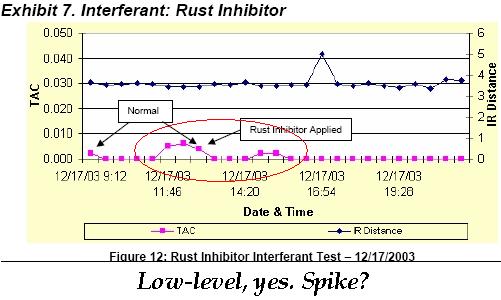
Now lets look at the subjects tested in AMS's "tamper-proof white-paper", all 10, a seven day study two of which no testing was performed. Ten subjects in 5 days and there were nearly no false-positives. Quote- This low-level reading occurred because the test subject worked in an area where alcohol was used to clean circuitry components. Except for this anomaly,..." Today there are at least 2000 people being tested 7 days a week (up to 48 times a day), I hope they don't have to suffer the consequences of an ANOMALY!
As far as the benefits, it does have one up on the EtG tests, and that is time of alledged comsumption. If your in an area where there are camera's or able to establish a credible alibi, and can possibly identify the source, it may create reasonable doubt.
The benefits of EtG, there would be no chance of suffering the abrasions and scars left from the SCRAM bracelet on a percentage of subjects. And longevity, pitting the two against each other in court was my initial goal! It has been said that at least one doctor is conducting a for-profit company promoting the EtG test, and is looking into SCRAM- {I 'd like to see the expert testimony in that case.}
Reiteration:
I have yet to hear of anyone accused of drinking through EtG test in the legal community, allthough steps are being taken to cut the cost of the tests, which poses a problem. A defendant could very well use this as a defense- and with an expert testimony. It has been also noted that a probationer in the health care community, that has a concurrent probation with the courts, a positive test may be considered a violation of both the probations. Double jeopardy for a crime that may have never been committed.-Marcellus

Wednesday, November 29, 2006

SCRAM: Sufficating the Constitution

While some may claim the Right To Privacy was abolished when one was put on probation, an alternative to jail where there is no privacy, other constitutional rights have been disregarded when ordered to wear such a device.
First and foremost, ''nemo tenetur seipsum accusare,'' that is, ''no man is bound to accuse himself.'' Most clients are in favor of wearing the device, confident they can adhere to the terms and ignorant to the possibility of an erroneous read, until they walk into an office building with freshly cleaned carpets, or cut their lawn and with no delinquent actions- Incriminated themselves. This priveledge was intended to eliminate coercion in interrogation and in testimony, which lawyers are ever so gracious for an opportunity to use ones wording (not meaning) against them and manipulate facts to impute guilt. In North Carolina they have been having problems with independant for-profit companies selling the device to defendants, and Greg Stahl, the AOC's deputy director, raised a possible constitutional issue with SCRAM. "Can an offender be charged money to monitor himself, and monitor himself in a way that he might go to prison if he flunks?" Stahl asked rhetorically. In researching I found this excerpt defining the Fifth Amendment-...nor shall be compelled in any criminal case to be a witness against himself, nor be deprived of life, liberty, or property, without due process of law; DUE PROCESS?

Now lets say there is a reading, false or not, a probationer will receive a letter in the mail which states the defendant is entitled to a hearing " to prove why he/she should not be held in contempt of court". In other words, Prove Your Innocents. While Presumption of innocents is not cited explicitly in the Constitution it is widely held to follow from the 5th, 6th and 14th amendments.The intent is to put the burden of proof on the prosecution for proving innocents can be near impossible, for instance it's often impossible to establish an alibi if the person is home alone at the time of the crime, which happens all too often with the SCRAM system. A great number of accusation seem to occur when the defendants are sleeping, and with no further investigation, the defendant is forced to reap the consequences or confess to a violation that may or most likely didn't occur in hopes for a lighter sentence. I am conviced that they do not want the burden of proof because that may lead to an undetermined amount of erroneous reads and deem such a lucrative product frivolous. Further investigation does not necessarily mean wasting tax dollars on a police dispatch...the Sixth Amendment give us the...
NOTICE OF ACCUSATION
Which states the constitutional right to be informed of the nature and cause of the accusation entitles the defendant to insist that the indictment apprise him/her of the crime charged with such reasonable certainty that he/she can make their defense and protect themselves after judgment against another prosecution on the same charge. Informing a defendant would warrant nothing more than a phone call and an innocent client would have the time needed for an actual toxicology test, and that would be reasonable certainty that he/she can make their defense. If you are thinking this is a post-conviction offense, it would appear the revocation of parole or probation which has been imposed following sentencing, and prison disciplinary hearings will be determined according to due process and equal protection standards rather than by further expansion of the Sixth Amendment.
Due Process, Right to be Presumed Innocent, self incrimination, 5th, 6th and 14th amendments are just a few of the Constitutional rights to sufficate when "we the people" allow our legal community to become over-zealous denizens of for-profit companies. With no scientific scrutiny they allowed a device so vulnerable it "can detect them (socks) too...", as quoted by Jon Ugval of House Arrest Sevices, to jeapordize the liberty and family's well being of unsuspecting wearers. I have not even explored the fact that in trial there is no evidence, other than the reading, that is the bracelet is not equipped with a device to save the incriminating sample to be observed by the defense. The abuse of process, the convictions secured from reasonable suspicion or The Right To Bodily Integrity. Since my first post there has been two studies not commisioned by AMS, and PIRE's research found two of the 18 test subjects endured minor bruising and these people were probably not under the same circumstances as an actual probationer such as, no drivers liscense, walking or bicycling to the requisite of meetings, counseling, work etcetra. My research has found that 4 out of 10 wearers are subject to incredibly painful abrasions and infections, which in some cases resulted in permanent scars, it is 8 ounces pulling on your skin with every step, every motion, and treatment for the abrasions is null for ointments and cleaners can trigger erroneous reads and the bacteria is trapped in the bracelet, but until there is an actual case of necrosis, concern much like the burden of proof is placed on the client!

-Mike Gephart, corrections unit supervisor for Hennepin County- In some cases, he said, people admit: "Yeah, I did have a couple of beers.But I'm done. Others are in complete denial and say, 'I didn't drink.' "Instead, the latter group blames the device for emitting a false positive,Gephart said. One individual, for example, insisted a hair-care product containing alcohol had somehow triggered a bogus reading. That person was issued a warrant and hauled back to jail. http://lawenforcement.usenetbot.com/archives/2003/10/27/P2.html
ON THE OTHER HAND:
The anklet also is sensitive to any alcohol that comes in contact with the skin. For example, one anklet registered when the man wearing it put on a shirt washed in a detergent that contained alcohol.
http://www.myrtlebeachonline.com/mld/myrtlebeachonline/news/local/12204846.htm
AND GEPHART AGAIN SAME ARTICLE:
Gephart said that like any new technology, there have been "minor" issues with SCRAM. In one case, authorities issued a warrant to put someone back in jail after a positive alcohol reading was triggered.But the warrant was recalled when officials couldn't "absolutely"determine a drinking violation occurred.Without going into detail, Gephart said the substance that triggered the reading is something that could be found on a construction site, as the probationer claimed.

Originally posted: 02/28/2006
REFERENCES:
http://en.wikipedia.org/wiki/Main_Page
http://lp.findlaw.com/

HOME

Tuesday, November 07, 2006

SCRAM: Illinois Buys It

Their hyping it up in Illinois-

[...]Some critics argue it's another example of Big Brother encroaching on personal liberties, but supporters contend it's the best tool yet for combating alcohol-related crimes and clogged jails and prisons.[...]
A Big Brother approach is an understatement...

[...]The eight-ounce ankle bracelet [...]

Will hobble one with abrasions, bruising, infection (How does one clean the wound?) and leaves permanent scars...

[...]"We still have to work out a lot of details," said Birkett, a lieutenant governor candidate, "but this is going to focus on people who clearly have an alcohol problem and their alcohol use is tied to their crime."
Ironically, one of the state's top DUI defense attorneys, Donald Ramsell, worked with the company on legal issues. He supports it as long as the program is voluntary and isn't abused to punish social drinkers.[...]

And the deciding factor can be how high the EBT result is, erroneous it may be...

[...]"You want to make sure it's accurate and that there's a process in place to appeal a reading if it's in dispute," said Ed Yohnka, spokesman for the American Civil Liberties Union of Illinois.[...]
Yeah, proving innocence is "virtually" impossible, in fact, impossible in most scenarios...
[...] 45.2 percent of fatal crashes in the state involved intoxication, compared to 39.6 nationwide.[...]

Completely inflated, fictitious statement, remove intoxication and add "a measurable amount of alcohol in any driver, occupant or pedestrian involved" and we are a little closer to 45%...

"I believe that most people would not mind the slight
inconvenience of being arrested for a low blood-alcohol
level, given the opportunity to prove their innocence …"53
Linda Campion, MADD presenter and founder of the Kathleen A. Campion Foundation

Tuesday, October 24, 2006

SCRAM: Setting Them Up For Failure

http://www.heraldsun.com/durham/4-779571.html

In this article, they point to another study on the TAC/BAC correlation, yet, what happens when the alcohol detected was not consumed? Already it is known that the device is non-specific, meaning the read can be caused by things other than alcohol much like the Ignition Interlock detects yeast products. I was recently contacted by a person claiming, "My son was sent to jail for about forty days for two probation violations because his SCRAM unit showed what Jeff Hawthorn called drinking episodes. We went to court and prevailed thanks to a Judge who ordered two probation officers to wear SCRAM units and spend an hour in close proximity to my son and the oven that he works by in a bakery. All three units indicated alcohol consumption. AMS and Jeff Hawthorn need to be held accountable for the losses that people incur do to SCRAM's inability to distinguish consumed alcohol from invirnmental alcohol. Seems as though AMS is able to profit from a hastily marketed product." Intersesting that they feel it necessary to bump a district atttoney who clearly has an interest in justice!

Guy added that he knows of at least one SCRAM case from Mecklenburg County where a defendant might have been better off financially had he opted for a lengthy prison sentence. "Are we setting these people up for failure?" he said.

Tuesday, October 17, 2006

SCRAM: Case Study

Washtenaw County-
Client obtained PBTs on Friday and Saturday mornings to try and show he was not drinking. Events seen later on days he obtained readings. Bracelet showed compliance at the time of PBT but drinking later in the day. Client sentenced to one year.

Why did the client try to prove his innocents? Probably because the prosecution was not looking for corroborating evidence.

41-B District Court-
Client claimed interferents in workplace created positive readings. Interferants were posted but AMS showed the difference between interferant readings and the predictable Blood Alcohol Curve. Client sentenced to 30 days followed by additional 6 months of SCRAM.

The ever so trusty TAC curve, not corroborating evidence!

40th District- SCRAM showed positive drinking. At hearing client admitted.

Client was most likely offered an easy sentence for the plea, rather than throw the dice. One wearer contacted me ready to fight, the plea offer was a $250 fine, as opposed to incarceration. See also Plea Bargain.

http://convictedinnocent.blogspot.com/2006/04/law-plea-bargain.html


KIRBY MAY-PROSECUTER SHELBY COUNTY TENNESSEE-May, who specializes in drunken-driving cases, has found the round-the-clock, 6.5-ounce monitor only slightly annoying — it tends to vibrate every five minutes and creases the skin if not positioned just right. Still, he's sold on it.''It's not for every case, and it's not really to punish,'' said May, who's kept a log of his alcohol intake to test against the monitor. ''But if someone's in rehabilitation and in (driving) safety school, it helps break that drinking habit.

Saturday, October 07, 2006

PBT: 40% Margin of Error

Already known is the partition ratio, a selected number used by all breath test machines in each and every test. As well as the ratio ever changing, so is your body tempature. It has been found that a rise in body tempature as much as 1.8 degrees can inflate the results up to 7%. Dr. Hlasatla had found a 6.3% error for every degree Centigrade increase or decrease from the presumed normal body tempature. Remember painting a room can cause a lingering .12, endogenous a possible .02, RFI .05, x 7% per degree of difference = Conviction.
In an fallacious effort to justify the result, the evidentary test will be administered until two consecutive tests are within .02 difference. If the first result is .10, anything between .08 and .12 for the second will be considered accurate, thus a 40% range of error not including the incredible amount of other Daubert issues with the devices.
As this becomes public knowledge, any of us can be convicted at anytime, and a growing number of states are eliminating jury trials for DUI cases, another strike at our Constitution.

Reference:
http://www.duiblog.com/2006/10/01#a482
http://www.duiblog.com/2006/06/20#a424

Thursday, October 05, 2006

EtG: SAMSHA Warning

Federal Agency WarnsThat Alcohol TestIsn't 100% Reliable
By KEVIN HELLIKER October 5, 2006; Page B1

A widely used method of detecting alcohol consumption in people prohibited from drinking is under assault from a federal agency that has declared the test too scientifically uncertain to be the sole basis for legal or disciplinary action.
The federal Substance Abuse and Mental Health Services Administration last week issued a so-called black-box warning asserting that the urine-alcohol screen called EtG doesn't offer surefire proof of drinking. Officials at the agency say the screen is so sensitive that a positive reading may reflect exposure to alcohol-based hand sanitizers or alcohol-containing foods or medicines. A carton of apple juice left a long time in the refrigerator could conceivably produce a positive EtG test, says Kenneth Hoffman, the agency physician who wrote the warning.
The warning represents a victory for the growing number of people who insist they flunked the EtG test despite having abstained from liquor. Their cases, replete with polygraph exams and other evidence of sobriety, convinced even the scientist who pioneered EtG screening in America that the test is prone to so-called innocent positives.
Whether the agency's warning will help these people reclaim the jobs that some lost after flunking EtG tests is unclear. In any case, the warning is a blow to the credibility of the $4 billion-a-year urine-testing industry, which introduced the EtG test two years ago as offering fail-safe proof of alcoholic-beverage consumption.
EtG, short for ethyl glucuronide, is a unique metabolite of alcohol that stays in urine for up to 80 hours -- four times as long as does alcohol itself. Earlier, detection of alcohol had been difficult because it dissipates so quickly. The wider window of detection made EtG an instant hit with drug courts, professional licensing boards and other agencies that monitor sobriety -- and an instant star of the urine-testing industry, which is performing tens of thousands of EtG tests per month in the U.S.
However, SAMHSA officials say the industry never conducted the large-scale clinical trials needed to prove EtG isn't prone to snare the innocent. No federal regulatory approval or rigorous trials are required for a urine-testing firm to introduce a new product or process.
Even after evidence emerged that the EtG test could detect incidental exposure to alcohol in food and the environment, many urine-testing firms continued marketing the screen as definitive proof of alcohol consumption. Some continue to do so. "EtG is not detectable in urine unless an alcoholic beverage has been consumed," says the Web site of a urine-testing firm called AccuDiagnostics LLC. An AccuDiagnostics spokesman attributes that claim to toxicologists at laboratories to which it outsources its samples.
At industry giant Quest Diagnostics Inc., the director of the Salt Lake City laboratory conceded during a July interview that exposure to alcohol in foods or medicines could produce a positive EtG score. After The Wall Street Journal published a page-one article on Aug. 12 about EtG tests, Quest removed from its Web site a claim that "EtG is not detectable in urine unless an alcoholic beverage has been consumed."
A Quest spokeswoman says the company regrets not removing that information sooner. However, Quest says that the claim was based on an internal study of 1,500 abstinent people, none of whom tested positive for EtG. That study wasn't published. The spokeswoman says Quest is carefully studying the SAMHSA warning.
The warning makes clear that the EtG test remains useful. Increasingly, drug and drunken-driving defendants, along with recovering addicts in high-risk professions such as health care, are required to abstain entirely from alcohol and illicit drugs. But monitoring these people has been difficult because while illicit drugs can be detected for days after usage, alcohol consumption has been easy to disguise -- until the advent of EtG. About 10% of EtG tests have turned up positive, the vast majority of them reflecting genuine violations of sobriety requirements.
But a small percentage of those positive findings appears to involve no wrongdoing. In one case, a California pharmacist named Lorie Garlick -- whose pharmacy license has been suspended since she failed an EtG test in the spring of 2005 -- quarantined herself in an addiction-treatment center with no access to booze and flunked the test again.
Because of such cases, "legal or disciplinary action based solely on a positive EtG ... is inappropriate and scientifically unsupportable at this time," said the SAMHSA warning, recommending that a positive EtG be regarded as a possible sign of relapse that triggers a broader investigation.
A negative EtG score appears to represent persuasive evidence of sobriety. This was what Gregory Skipper, a physician who runs the Alabama monitoring and assistance program for recovering doctors, was seeking when he helped to pioneer the EtG test along with some European doctors several years ago. As a recovering addict himself, Dr. Skipper understood that malpractice insurers and state licensing boards desire documentation of abstinence. Dr. Skipper, who supports the SAMHSA warning, says he hopes it doesn't overshadow the EtG's value as a marker of sobriety.
Many urine-testing firms say that they merely provide the EtG results and that their clients -- drug courts or professional licensing boards -- bear responsibility for deciding whether a positive finding represents proof of drinking. But some urine-testing companies themselves have guided clients to interpret positive results as proof of drinking. On a laboratory report stating that Nancy Clark, a Pennsylvania nurse, had an EtG score of more than 300 nanograms per milliliter, National Medical Services included the statement that "any value above 250 ng/ml indicates ethanol consumption."
Ms. Clark has passed a polygraph test stating that she hasn't drunk, and her 12-step group awarded her a medallion in May honoring five years of abstinence from alcohol and drugs. But two positive EtG scores prompted Pennsylvania to suspend her nursing license early this year. Now, the 20-year veteran of nursing waits tables at Charlie Brown's Steak House in Reading, Pa.
The state has argued that it wasn't accusing Ms. Clark of drinking, only of failing to produce clean urine.
Write to Kevin Helliker at http://www.blogger.com/l
http://online.wsj.com/google_login.html?url=http%3A%2F%2Fonline.wsj.com%2Farticle%2FSB116000249565983045.html%3Fmod%3Dgooglenews_wsj

Sunday, August 13, 2006

EtG: The Wall Street Journal

http://online.wsj.com/article_email/SB115534928148134109-lMyQjAxMDE2NTE1MjMxNDI5Wj.html

"Some in sobriety enforcement contend any alcohol, however ingested, could trigger a relapse in recovering addicts."-Kevin Knipe

This rhetoric supports the testing, while stating that fueling a vehicle, eating pickles and sanitizing a childs dwelling are good reasons to take a childs mother away. This is by no means constructive, trust me I've been there, although my offense was showering or wearing socks. There is absolutely no research (that I've come across in over a year of study) that supports a theory that cleaning a bathroom or fueling a car is a trigger for relapse. A positive, false or not, usually means added treatment, in my opinion this jack-ass is more interested in revenue rather than constructively helping one with a disorder.

They have not even touched base with the possibility's. When asked how Tylenol causes a false-positive, I found that it as well as many OTC drugs (Motrin) are methylated. Ethynyl estradiol used in oral contraceptives, estradiol stimulates the enzyme primarily responsible for creating EtG, (possibly why the research that made this "the Gold Standard" was over 40 men and three women), making most women hyperproducers, add ethynyl and BAM. This is the alternative to SCRAM in continuous monitoring, a couple of state's HPRPs have already suspended use, one group and 80% of the clients were positive, would 8 out of ten people jeopordize their livelihood? It is far less reliable than SCRAM, and one case with a read of 121,000 and the Dr. had doubt, as opposed to the 100, 250, 500, 1000 and 1500 the article discusses.

Tuesday, August 08, 2006

SCRAM: Relapse Prevention Myth

1) A clients story through the eyes of his lawyer.
http://www.kjlaws.com/blog/blogentry.2006-06-28.6836626870
2) This lawyer is researching!
http://www.kjlaws.com/blog/blogentry.2006-07-28.5804110687
His premise is that the device may detrimentally impact a clients ability to stay sober for it is quite audible causing "continuous" embarrasment and sleep deprevation. The pain and discomfort of 8 ounces pulling on your skin with every step was compared as "a shade better than a medieval torture device". He cited concerns that "the torment of having this unproven appliance reporting your daily intake of food or other products that the manufacturer admits may provide false positives would push even the emotionally firm to the brink of a stiff drink". After an erroneous read, proving innocents is nearly impossible with the methods of use AMS suggests, so one may think might as well, going to jail anyway! Jeffrey Hawthorne, admitted under oath, that SVRAM was not designed for use as a quantitative analytical device. Also, he admitted that there are too many factors that cannot be controlled. He reported that it is only a screening device. So Jeff, why propel the device claiming AMS can distinguish between consumption and exposure?This lawyer also noted nobody knows when and if the bracelets are calibrated, I read elsewhere another expert saying the device should be calibrated every 24 hours. Again this brings concerns about the cleaning of the device, transcommunicable infections are not myths, and with water and dead skin in the bracelet, staph infections do pose a threat and I have some pretty credible witnesses to that. My favorite quote," ,"Either AMS gets these questions answered and wrinkles smoothed or defense attorneys are going to have this purported science dropped on its proverbial head. Until then, unfortunately, judges continue to use SCRAM and alleged offenders continue to go to jail for alleged positive TAC readings."

I CAN GO YEARS, BUT THANKS TO THE SIX MONTHS OF SCRAM?
Some DWI offenders don't learn their lesson until it's too late. But what if there was a way to keep them from having even one drink? Now there is. A device that tells authorities if you have been drinking at any time can be locked onto an ankle serving as a constant reminder. And while some complain it's like big brother, many believe it will prevent convicted drunk drivers from committing their crimes again. Ronald Markek is an admitted alcoholic. “You see, I can go 3 or 4 years without drinking and all of a sudden there's some urge in me that I gotta go out and get loaded and every time I do, I get caught and I wind up in court." http://www.sandiegoduihelp.com/blogarchives/2006_05_01_index.html

Thursday, August 03, 2006

SCRAM: 50/8000

In my eight month's of SCRAM, I had been in for many regularly scheduled maintenance appointments. During one of these visits, a woman, not a large or masculine woman, broke the strap while putting it on my leg. At the time it was of no concern to me, until a concerned mother contacted me of an occurance which had her daughter incarcerated. Her story follows.

Apparently the strap broke while she was at work, and she had witnesses. She called the monitoring office and got an answering machine, her therapist, and arrived at the office attempting to explain the situation. The montoring office called AMS, the represenative advised that she had not come across any case where the band had just come off the ankle without force or being cut. The defendant was not afforded a hearing and after the charged with criminal damage, (a felony), charged for the whole system-$1400, and sent to jail. Fortunately, they kept the bracelet for further investigation and Royce McDonald (technician) advised that there was no identifiable offender damage to the front strap of the bracelet, McDonald further related that AMS has seen this kind of damage on less than 50 bracelets out of more than 8000 built. The charges have been refused, yet the defendant had to finish her inpatient program. This is another example of the fallibility's, the misuse of over-zealous probation departments and/or electronic monitoring companies, the effects of continuous monitoring and is neither justice nor constructive in rehabilitation.

Contradiction:
SCRAM wearers are told not to spray perfumes, hairspray or wear alcohol-based lotions, to avoid testing errors. Monitoring specialists at AMS, however, are able to determine whether or not an alcohol reading was triggered by alcohol consumption. Alcohol that has been consumed stays in the body longer and can be detected by the sensors longer, according to Kathleen Brown, AMS spokeswoman.

Thursday, July 27, 2006

Law: Is EtG Testing the Answer (part 2)

I stumbled on this theory when I saw ethynyl estradiol caused fasle-positives, ethynyl made sense but estradiol? Today, the vast majority tested with this seem to be women, yet the founding research was mostly men, which leaves me to believe Dr. Skipper (responsible for bringing EtG testing to the U.S.) after dubbing it an absolute bio-marker of alcohol consumption despite gender bias research, was well aware of gender bias and/or the possibility of, and his continued stride to use the test while custody, liberty and livelihood are purloined by the claims of surrepititious drinking only add verocity to my assumption. His newest little study inspired some more research of my own to corroborate with my hypothesis, or prove it wrong. I found in conjunction with my gender bias thoery," But, when normalized for total body water, women metabolize ethanol 33% faster than men, due to a proportionally larger liver." Accelerated UGT1A1 (primary enzyme responsible for production of EtG, stimulated by necessity) expression due to the elimination of E2 (natural estrogen, estradiol), ADH (first pass, first elimination of ethanol) less prevalent among, and a proportionally larger liver logically equals a hyperproducer. Dr. Skipper has started a research protocol to establish how these false-positives are occuring. The list of contaminents range from anything that has the molecular structure of ethanol such as vinegar, foods cooked with wine, even over ripened fruit, and an inhalation issue has been raised as well. If this test is positive for anything that had the molecular structure of ethanol such as vinegar, any substance in the "meth" catagory would as well create a false-positive. It is also noted that Tylenol may create false-positives, most likely due to the fact that it as well as many over-the-counter remedies are methylated (1.To mix or combine with methyl alcohol. 2.To combine with the methyl radical.), yet his protocol states:
Some individuals have tested positive for EtG but deny drinking. There are only threepossibilities for this phenomenon.
1. They are being dishonest or in denial and they actually consumed beverage alcohol
2. They are being honest and are not in denial but consumed “incidental” alcohol(from OTC meds, food, hygiene products, or other).
3. They produced alcohol in the GI tract in sufficient quantity to trigger a positivetest. (This is only a theoretical possibility at this time and hasn’t beendocumented.)
Endogenous- ADH is known to eliminate a small percentage of endogenous alcohol, how does the Doc believe the remainder is eliminated? True, .02 is a high endogenous level, but not as uncommon as one might think with certain food combinations (chocolate doughnut), which again would stimulate 1A1 expression leaving one vulnerable to outside influence and adding to the existing EtG. Make no mistake, the only possibility for this phenomenom is the vast amount of contaminents in corroboration with the lack of research on such contaminents, hyperproducers etc... and hiding behind the facade of the virtuous goal of identifying these secret drinkers. I am confident the majority of claims of erroneous reads are not "surrepititious drinking" as the Dr. would have you think, again referring to the list of contaminents and incredible amount of claims, Bayes Rule applies, and of course common sense.
Impressive is the fact that Skipper is going to conduct tests in a supervised setting:
Auto-Brewery Syndrome Test Protocol
(May be performed initially in an unsecured setting, however, for forensic purposes thetest should be performed (or repeated) in a secure environment (search belongings, in asecurely supervised setting where no ethanol is available, etc))
Well skeptics say this has been done before, and they continue to impute guilt rather than address the seemingly obvious. It has been said that one study was conducted with nuns and a regular rinse with mouthwash, when one tested positive they stated that self-reports of consumption are usually not reliable, so the nun lied.

Thursday, July 13, 2006

LAW: "Horizontal Gaze Nystagmus"- The Eye Test

The "Horizontal Gaze Nystagmus", one of the most recent additions to the field sobriety test, and increasingly used amongst law enforcement, has been proven a fallacy time and time again, yet it can and will be used against you in the court of law. It has been said blood sugar, caffeine intake and nervousness are ingredients for failure. Not only is it fundamentally flawed but it is rarely administered by officers properly.The Horizontal Gaze Nystagmus (HGN) test was conceived, developed and promulgated as a simple procedure for the determination of the blood alcohol concentration of drivers suspected of driving while intoxicated (DWI). Bypassing the usual scientific review process and touted through the good offices of the federal agency responsible for traffic safety, it was rushed into use as a law enforcement procedure, and was soon adopted and protected from scientific criticism by courts throughout the United States. In fact, research findings, training manuals and other relevant documents were often held as secrets by the state. Still, the protective certification of its practitioners and the immunity afforded by judicial notice failed to silence all the critics of this deeply flawed procedure....In 2001 new research indicated that the Horizontal Gaze Nystagmus (HGN), the cornerstone of the test battery was fundamentally flawed and that the HGN test was improperly conducted by more than 95% of the police officers who used it to examine drivers suspected of driving while intoxicated.This summary critique demonstrates that it is scientifically meretricious and that the United States Department of Transportation indulged in deliberate fraud in order to mislead the law enforcement and legal communities into believing the test was scientifically meritorious and overvaluing its worth in the context of criminal evidence....(1)Again, not accepted by the scientific community, yet crucial evidence to the legal community, deliberate fraud they say. The final quote from my resource states,"...silence from the scientific community cannot be considered an endorsement of the program."(2)Some quotes:"Using nystagmus as an indicator of alcohol intoxication is an unfortunate choice, since many normal individuals have physiologic end-point nystagmus...Without a neuro-opthalmologist or someone knowledgeable about sophisticated methods of eye movement recordings, it is difficult to determine whether the nystagmus is pathologic. It is unreasonable that such difficult judgments have been placed in the hands of minimally trained officers. Dell'Osso, "Nystagmus, Saccadic Intrusions, Oscillations and Oscillopsia", 147 Current Neuro-Opthalmology 147.""Nystagmus can be caused by problems in an individual's inner ear.... Physiological problems such as certain kinds of diseases can result in gaze nystagmus....Furthermore, conditions such as hypertension, motion sickness, sunstroke, eyestrain, eye muscle fatigue, glaucoma, and changes in atmospheric pressure may result in nystagmus. The consumption of common substances such as caffeine, nicotine, or aspirin also lead to nystagmus almost identical to that caused by alcohol consumption. State v. Witte, 836 P.2d 1110." (3)
1) (Booker, 144(3) Science and Justice 133-139, 2004),
2) http://www.duiblog.com/2006/06/28#a422
3) http://www.duiblog.com/2005/06/13#a198

Wednesday, July 12, 2006

PBT: Daubert vs. Daubert

Sharper Image agreed to stop selling personal breath test devices and pay $1.2 million in restitution as a part of a settlement regarding the device. The company claimed the "Digital Breath Alcohol Tester" was accurate to .001 percent BAC, they are also to pay $100,000 in penalties for the ficticious claims. Apparently a city employee compared the results with one used by the cities police department, which only leaves unanswered questions-Was RFI involved in either of the reads?Is this employee qualified to use them? Do they understand mouth alcohol and the time it dissipates?Was either PBT right?How does one know the police issued machine is the correct? Even if a device is specific to alcohol, it most likely is not specific to ethanol, and some other forms of alcohol last longer and will trigger an erroneous read. The list goes on, but as pointed out through much research and past posts/links here, there are too many factors when measuring the contents of blood by breath, to ever get an accurate read! Partition ratio, RFI, endogenous, food combinations, mouth alcohol, equilibrium, breathing, calibration............
http://www.businessweek.com/ap/financialnews/D8INE6780.htm?sub=apn_news_down&chan=dbhttp://www.martinrothonline.com/personalhealthmonitor/ http://www.montereyherald.com/mld/montereyherald/news/breaking_news/14989509.htm

Saturday, June 17, 2006

Law: Continuous Monitoring (Ca. AB 1832)

California's AB 1832 (Introduced by Rudy Bermudez, who is running for senate. Would his being a "victim" of a drunk driver distort his views on justice?) is a bill that makes "continuous monitoring" a legal alternative to incarceration. While most would agree this is certainly a more constructive approach, the research quoted has it's skeptics. "According to the author, "Studies have shown that a driver who has been convicted of one or more DUIs is almost twice as likely to be involved in a fatal accident, killing or injuring themselves or others." I've seen other studies that show that a near 90% of actual drunk driving fatalities are first time offenders, but zeal can't be reasoned with. After reviewing the NHTSA's FARS Database (Ca. 2003), fatal accidents where all drivers were tested resulting in .00, accounted for 117 "alcohol related" deaths, and of the 1626 "alcohol related" deaths, 922 were where the driver was tested .08 or greater.
Redundant I know, but our legal community continues, and so will I. The report quotes this on SCRAM, "An environmental alcohol curve will be characterized by a steep rise to peak, remain at that level as long as the bracelet remains in the environment, the display a sharp decrease back to the zero base line once the bracelet is removed from the contaminated air." The picture is an unexpected contaminent during the testing, and proves vulnerability. Once the bracelet is removed from the contaminated air, the bracelet need be worn tight, that air is not just quickly removed. PIRE's research also showed us that water accumulates in the bracelet, ethanol is miscible (highly soluble) with water, which again can and does retard the diffusion. And children have lost their parents because of a "curve". This low-level read lasted in excess of two hours with a gradual decrease, anoter obfuscation is the fact that it can't read past .08, so ones TAC may have been at .79, yet a retarded diffusion will still impute guilt.
"Research was conducted on more than 100 different individuals providing thousands of SCRAM TAC to BAC comparisons. The conclusion was that there is a reliable correlation between SCRAM transdermal alcohol concentration and conventional breath tests results over varying periods of time on typical individuals under varying degrees of alcohol intake." OK, so when one drinks, they transdermally emit ethanol, that study is done, and most was completed in 1992 by Robert Swift, before AMS existed. Any studies done on the abrasions and scars left by the device? Are they sanitized before reuse, and with what? How does one treat the wounds? Would not the bacteria accumulate in the bracelet, in the water? For-profit is not synonymous with for-justice. The duration can last up to three years, and while AMS has backed it's claim that 40% of wearers still drink or tamper to 18%, I am convinced that no human can wear this device for three years without a violation.
More: "While the number of alcohol-related deaths due to traffic fatalities has increased, so too has the total number of traffic deaths, though the percentage of total traffic fatalities due to alcohol remains at, or near, 40%." False, the NHTSA includes intoxicated pedestrians and passengers, (Ca. 2003) of the 1684 listed as drunk, 806 were tested over .08. NHTSA listed 878 drivers with no proof, under the "legal limit", and includes over 121 drivers at .00.

Arguments:
a) The California Attorney for Criminal Justice (CACJ) states, "CACJ is concerned that SCRAM devices have not been found to be wholly reliable. There is a scarcity of independent studies confirming the accuracy and reliability of these devices. For this reason, the North Carolina Administrative Office of the Courts has issued a warning to judges who want to mandate the use of the devices. There is too great a risk of false positives. CACJ is concerned that these untested devices will result in the wrongful incarceration and conviction of thousands of Californians. Yet, this bill does not establish any regulatory oversight, minimum product standards for SCRAM devices, or impose basic training requirements for individuals operating these devices. Without these safeguards, the State cannot ensure that SCRAM is reliable in every case. By contrast, the State has adopted extensive regulations governing the use of breathalyzers to reduce the possibility of unreliable test results.
b) The American Civil Liberties Union states, "We are concerned about the accuracy and effectiveness if these devices. We are concerned that these devices will have the same problem that the drug-sweat-patches have (e.g., false positives and defects that will be interpreted as tampering). Providing our concerns about the accuracy and effectiveness of the devices are met, we raise the following issues for your consideration: There are no time limits on the device and this bill also requires 60 days of abstinence before the person no longer must use the continuous alcohol monitoring devices. This looks an unintended consequence of the amendments (eliminating the three-year maximum) that should be clarified. Allowing the imposition of an alcohol monitoring device for driving with a suspended license (Vehicle Code Section 1460.2) with no indication of alcohol use (other than the initial DUI) seems unduly intrusive and unrelated to the offense of driving without a license. In practice, this requirement could mean an individual could have a continuous monitoring device imposed after being convicted of driving without a license after a single DUI (this could be years after the original DUI if the person never went to DUI school). Finally, we suggest that the individual's ability to pay for the devices be considered before any costs are imposed."
c) The Taxpayers for Improving Public Safety states, "This bill is overbroad and would lead to continued false positive readings by such devices for behavior which is entirely lawful. Notwithstanding personal viewpoints about whether or not such persons should continue to drink alcohol at all, the devices which would be utilized as a result of this bill have no means of differentiating between the detection of alcohol which is consumed in conjunction with driving and alcohol which is consumed in the privacy of one's own home with no connection to driving. Unfortunately, it is also unclear as to who would actually monitor these devices for the positive identification of alcohol and through what resources we would fund the monitoring. Law enforcement in general, including probation officers, already has a difficult time responding to the needs of communities. The overbroad application of the target technology seems wasteful of already scarce public safety resources. Vehicle ignition interruption devices would appear to be a more focused and reliable means of addressing DUIs."


Support also comes from members of the judiciary and special interest groups such as MADD. This would make California the 5th state to enact a law that makes this a sentencing option. I wonder if Bermudez, is aware of how many subjects were convicted for wearing socks or incidental exposure, justice or simply interested in furthering a political career?

Reference:
http://info.sen.ca.gov/pub/bill/asm/ab_1801-1850/ab_1832_cfa_20060417_131352_asm_comm.html
http://www.autospectator.com/modules/news/article.php?storyid=4590

Tuesday, June 06, 2006

LAW: Another Crushing Strike Against Our Constitution

While I've researched the fallibility's of alcohol detecting devices, law enforcement is not usually my topic of study. It was once said that our legal system was designed to be 85% effective. While some innocent may get caught in unusual circumstances leading to a conviction, a guilty man may be dismissed on charges where the investigators failed to gather/present direct evidence, the latter being the greater number. Today, as prosecuters use the plea bargain as a weapon and our Constitution fading to memory, in my opinion the legal community has lost sight of protecting the innocent and gained an interest in cashing in on guilt.

California Police may enter a house without warrants to arrest suspected drunk drivers, ruled by the California Supreme Court. The decision follows similar rulings in nearly a dozen other states. Justice Marvin Baxter wrote that the loss of evidence at issue was obtaining a measurement of the suspect's BAC. Critics fear that this will give carte blanche to the police to assume one was drinking and enter their home while they are sleeping to arrest them. With the anonymous phone tip, it introduces a host of negative possibility's such as: swerve to miss an animal, get invaded and arrested. Not to mention the angered ex, neighbor or officer! What about the restaurant employee who's vehicle was parked outside an establishment that serves liquor? Don't be alarmed if your an attractive person, the genius Baxter wrote, "In holding that exigent circumstances justified the warrantless entry here, we need not decide, and do not hold, that the police may enter a home without a warrant to effect an arrest of a DUI suspect in every case,".
The case that set the precedent was one where a neighbor claims to have seen the defendant driving, one who may have had an ax to grind? Apparently the ACLU took a case where the police found the wallet of a girl who had attended a party where there was underage drinking. They found her driver's license, showed up at her parents' home, got her out of bed, and gave her a breath test to see if she'd been drinking (not even driving -- just underage drinking). All without a warrant. The girl hadn't had a drop. But she took the test anyway, passed it, then sued.
A good read:
http://www.duiblog.com/2005/05/09#a162

Reference:
http://www.theagitator.com/archives/2006_06.php
http://cbs13.com/topstories/local_story_152182332.html

Wednesday, May 17, 2006

Law: Consumption or Inhalation?


To do this research I had to use alternative inhaled forms of such as:

Methyl tert-butyl ether (MTBE), and ethanol are used in oxygenated fuels-It is now absolete, but were talking inhalation here.
MTBE equivalents rapidly distributed to all tissues examined, with the largest percentages distributed to liver. An inhaled dose that is, then I found:"In urine of humans, 2-methyl-2,3-butane diol, 2-hydroxy-2-methylbutyrate and 3-hydroxy-3-methylbutyrate were recovered as major excretory products in urine."
About 41% of the inhaled dose appeared in the urine (as metabolites other than TBA- the biomarker)." The major metabolite, comigrated with synthetic α-hydroxyisobutyric acid, and accounted for 70% of the total MtBE associated metabolites excreted in the urine. A second metabolite, identified as 2-methyl-propane-1,2 diol accounted for 14% of the urinary metabolites."Two additional, unidentified metabolites accounted for 15% of those in the urine. This research paper was published 12/1998, so even if the unidentified metabolites were not EtG, my research suggests that inhalation and dermal exposure could trigger an erroneous read, in combination more so, such as cleaning a bathroom!
Dr. Skipper, responsible for bringing EtG testing to the U.S. has elaborated-
Skipper said there were 61 people who reported to his EtG registry and 15 of them had undergone testing on their own. Most of the rest of his talk dealt with using clinical correlation and he also made slides of that list household items containing alcohol, which he says causes him concern. Then he introduced a doctor with the Michigan HPRP. He said they were having a problem with positives. They had 2 RN's, both female, both pregnant, positive EtGs were 150 and 270, and both denied any alcohol except cologne and hand sanitizer use (30 times a day). He noticed after applying Purell himself that he felt kind of light-headed, so he did a BAC and it was 0.02! Did it on others after a single application and BAC's ranged from 0.01 t0 0.035 . So he did a Purell study, with 24 participants. Divided them into 4 groups: skin + inhalation, inhalation only, skin only (used a laminar flow hood to prevent inhalation of Purell fumes) and control group. They then drew BACs at 20, 40, 60, and 90 minutes. The group with both skin and inhalation of Purell showed significant rises in BACs. What it showed them was that INHALATION is a major absorption route for Purell, not skin absorption. They are trying to get it published. The implications here go further than just Purell…hairspray and perfume…any inhaled source of alcohol

EtG- The lack of or absence of alcohol dehydrogenase, due to the type of alcohol/intake means that exhaling is the only means of elimination other than glucuronidation. Dermal exposure is similar, but less effective method of transfer, in corroboration with inhalation (say cleaning a bathroom), and those with a hyperproductive pre-disposition are vulnerable.

SCRAM-Inhalation of Purell produced a BAC of .02, amount of exposure may be more significant if one were to work in a room where the carpet had just been cleaned, thus therefore possibly registering in more than one way by the SCRAM system, and easily exceeding the .02 tolerance.

Today, there is talk of launching PEth tests as a confirmatory test for the claims of false-positive, yet again, little published research on the topic, but may help establish a defense for it is detectable for a week.

A computer modem in the wearer's home is programmed to pick up information from the wireless monitor throughout the day, and any detection of alcohol causes the device to
immediately search for the modem and send a message to authorities.
William Burrell agrees. The Temple University criminal justice professor says the monitoring devices "assume perfect behavior and allow no margin for error. Not every violation is worthy of return to prison. This country has a fascination with
all things technological," he said.
"But we don't always have the capacity to use it effectively."


SCRAM Links

Thursday, May 04, 2006

SCRAM: Progress?

It still concerns me that Rule 702 is an open door to for-profit companies to sell injustice. The SCRAM system continues to flourish, with little research done outside AMS's "Tamper-Proof" White Paper, and nothing that documents absolute reliability. The obfuscations are vast and as said in the past, a simple Constitutional procedure for use may remedy some fo the Daubert issues.

Suffolk County has decided to purchase 20 bracelets and kick-off a pilot-program, this time, however they don't seem to be inclined to use it as direct evidence as in the past. John Desmond, director of the Suffolk probation department, cited what appears to be concerns for justice.
"Although the devices have proved accurate in most tests, there have been cases that resulted in false positives, due to the wearer applying perfume or other alcohol-based products", Desmond said.
"It's important that the probation officers contact these individuals when they get an activation and administer a urine test or Breathalyzer," Desmond said.
This is what is needed to establish a known or potential rate of error. The Cleveland suburb Garfield Heights Probation officer Mark Mattern tested the device and claimed it can't be fooled, becareful- it can fool you!!

Durham, N.C.
"It's allowing somebody from outside the [court] system to make money off the system," said Nifong. "To allow a private company to come in here and skim money is something I'm not on board for."
Nifong said he was concerned by the fact that DWI suspects must pay a $75 hook-up fee and $12 a day for the SCRAM device,... "This is a way for people with money to get something people without money don't have, and the courts shouldn't be part of that," Nifong said....Nifong also said that some non-English-speaking Hispanics may pay for the SCRAM service under a misconception that it is guaranteed to help them in court, when it isn't...
SCRAM representatives deny reports, circulating in some court circles, that they charge a fee to disconnect their alcohol-sensing equipment from users.
Still, Judge David Q. LaBarre last month issued an order in the Durham DWI case of Adrian Lopez, saying the SCRAM program "refuses to remove Mr. Lopez's bracelet until he pays them an additional $175." In addition, SCRAM failed to give the court any information about the suspect's alcohol consumption -- if any -- because Lopez couldn't afford the $12-a-day monitoring fee, LaBarre wrote.
Lopez's bracelet soon was removed without any cost to him.


SCRAM Links

http://www.nydailynews.com/boroughs/story/413861p-349891c.html

Friday, April 21, 2006

SCRAM: What I See...

I have been contacted by a near thirty wearers, one has readily admitted to delinquently obstructing the bracelet---
After reading saran wrap and a trash bag didn't mask a drinking episode, and a read occured on a wearer that worked in an area where alcohol was used to clean circuitry components, obviously it doesn't take much an external contaminent to register. To further explain the sensitivity, the legally accepted partition ratio (parts blood to alcohol) is 2100:1 for a breath test machine, SCRAM is 15,000:1. This ratio is used to establish, as they call it, a reliable estimate of BAC. Since the terms of wearing the bracelet is abstinence, a BAC isn't necessary, and the graph only shows up to .08.
During research, I found that inhaled or dermal exposure to alcohol is metabolized a little different than consumption. That is there is a lack or absence of "first pass" where most consumed alcohol is eliminated, due to type of exposure or type of alcohol. This means the alcohol is directly introduced into the bloodstream, where the greater percentage is carried to the liver to be broke down and elimated, and while I'am convinced EtG is produced in this manner, there is no found research on these types of exposures on either SCRAM or EtG testing. In theory, a machine so sensitive (15,000:1), there may be a possibility a read can occur during the transport and final elimination of vapor or dermal exposure, add the consumption of ripened fruit (can contain up to 4% alcohol) or certain food combinations and "virtuality" becomes more a reality. They claim, "those who have not consumed alcohol do not produce signals that can be interpreted as an alcohol curve." But wait there's more;
PIRE's research showed that "spikey" reads may be from water accumulating in the bracelet, well, alcohol is attracted to water -- that is, it is soluble in water. Water trapped in the bracelet, accumulating in the sensor, ethanol is miscible with water which may explain the retarded diffusion that creates the curve, which adds to my original hypothesis that diffusion is retarded by the alcohol being trapped between the bracelet and skin. Most complaints I have heard of false-positive the reads lasted from 8 to 13 hours, unfortunately the print only reads to .08 which obfuscates the actual high point when proposing allegations against a client. For example, one may have reached a level of .53, then the diffusion started, from .08 to .00 it might resemble a curve, but there is nothing accounting for the period of time not read. A prosecuter can show when the alledged episode started, and blame any lapse in time on continued drinking, showing the end curve as proof of consumption- Maybe this lapse in time accounts for more of the virtual, in virtually no false-positives! Since no corroborating evidence is necessary for conviction, and/or a fictitious plea (the prosecuters favorite weapon) the amount of actual false-positives is unknown.

A peek at what I see:

Case 001: We are in the process of a false reading and are ready to persue all information on this subject. What and how do we obtain any experts in this area to get in contact with? I would appreciate any input as this a very unfortunate way to monitor alcohol related testing. Thank you for any input. We would be interested in hiring any expert to properly communicate on this subject....We have a very good lawyer but this is an interesting case in that my daughter called the scram supervisor and told her she was working as a hair model and she told my daughter to go ahead and get her hair done. The hair show used a product that contained alcohol and it read that she consumed the alcohol as opposed to topical. She has about ten people that will testify at 11 am she was not drinking and that a product was used that contained alcohol. The scram supervisor admits telling my daughter to get hair done. The discrepency is the reading. My daughter will volunteer a lie detector test as well as all of the witnesses who were with her in a professional setting. The reading so far is a low level with a burnout.

During the hearing.......

The doctor testified and explained all of the variables here.The city atty said it was possible our dughter drank for 13 hours a liittle bit at a time.
....Sound like an alcoholic??

After a long battle............

I can finally send this e-mail to you with good news.NOT GUILTY was the verdict after this long haul. The hearing was so amazing! The woman from scram was on the stand for a very long time and she made the most unbelievable statements. First of all she agreed that she really did not understand how to tell any difference between drinking alcohol or the absorbtion of it. Secondly she made the statemaent that there is no training or scientific evidence to train them, other than putting the bracelet on and waiting for the graph to sound an alarm if there is a reading. Lastly she said she remembers talking to our daughter and it "sounds like something i would say" (refering to getting her done). The prosecuter came up to our daughter after the verdict and said"the right decision was made, I could not have slept thinking you might go to jail" She then gave her a hug. What a crock if they think this is B.S. then why do they continue to use it?
Case 002: I was falsely accused of drinking and I expect I probably will be accused again. I was at work all day the day they said I was drinking all day. I took proof of this to my P.O, who told me "dont let it happen again". I have no idea how to not let it happen again, I look at the ingredients on the products I buy for my hair, skin, ect. and have not drank a drop. Isnt there a some way to insist that we are notified in a timely manner so that we may take a BAC to PROVE innocence? I am already developing a big abrasion, and I've only had this on for two months, which I think is a health issue....
Case 007
...Her charges aren't alcohol related, but as part of the program they are required to wear the SCRAM monitor. The ankle monitor she was wearing broke off and they charged her with criminal damage of $1400, which is a felony. She was at work at the time and had numerous witnesses who saw that it broke, that she didn't take it off. My husband, who is an engineer, saw the strap and wasn't too worried about it because in his opinion there was no way they could say it had been tampered with because it broke at the clasp....
Case 003: I have been placed on an Intermediate Punishment Program in _____----., and have had a great deal of respect for Judge Michael Barrase's effort to bring Recovery into the legal arena until recently. I was apprehended and returned to Lackawanna County Prison when my bracelet registered a positive reading for alcohol. I have been clean and sober for 9 mos., and can only attribute this reading to my use of cleaning products. I spent about 30 days in jail before I came to the realization that my P.O. as well as the judge were also victims of the claims from AMS and decided my only chance of getting out would be to admit to drinking even though i had not, as the system had relayed a message to my father that they were not trying to punish me they wanted to help me, but were waiting for me to get honest....
Otherwords, Those protecting a multi-million dollar investment wouldn't lie, nor the person who admits to drinking to opt out of jail.

No telling who lied, for I know and have reasonable doubt. Should their children lie, for millions or liberty, what's worth more???


Thanks to developmental support the National Institute on
Alcohol Abuse and Alcoholism (NIAAA), there has been
more published research about the WrisTAS device than the
SCRAM Bracelet...Because AMS is privately funded, most of SCRAM’s
research to-date has been unpublished....

Wednesday, April 19, 2006

LAW: The Surrogate Prosecuter

The fallibilities of alcohol detecting devices or any admittable scientific evidence is not limited to the device itself. Expert testimony is usually paid for, and as recently exposed, the questions can be prepared before there is even a case. This testimony will either protect an investment or defendant, and when asked a question one doesn't want the information released, they can just testify ignorant,"not that I know of". An investigation by the Mercury News for an article showed how judges are acting as a second prosecuter in a fourth of jury trials in Santa Clara County.

Judge Edward Lee is a former police officer who went to law school and served as a deputy district attorney before becoming a judge in 1991. Attorney Elissa Eckman said of the trial of Carlos Guerrero. ``It was like having two prosecutors in the room giving closing arguments. Only, one of them was the judge.'' Lee apparently questioned a witness, then later gave a closing analysis of his own to the jury, on issues raised during his questioning. The victim in this case, nowhere to be found, so an officer quoted the victim as accusing Guerrero, the two other gang members with Guerrero that night testified that not to be true. The judge relentlessly tried to discredit the gang members testimony calling them convicted felons and naming one a convicted perjurer. The jury was still deadlocked, but how would this case have turned out without the second prosecuter, a fair trial by a jury of peers..........Eckman later challenged Lee's conduct in the case, contending he demonstrated bias.
Then, two years later, attorney Thomas Orvis sought to have Lee disqualified in a case by arguing that the judge had established a pattern of bias in other cases including Guerrero's. Lee, he said, ``has a habit and custom of acting as a surrogate district attorney.'' While veteran judges cited concerns that this behavior invites trouble, the judge remains behind the bench, and he said, in recent years he has not offered jurors his own summation, nor has he engaged in questioning witnesses.
What was found:
Jury instructions. In 48 cases, judges failed to give the jury appropriate guidance on the law -- in ways that either bolstered the prosecution's view of the case or undermined the defense's contentions. As he directed jurors in a gang slaying case, a judge refused to tell them they should convict the defendant of manslaughter, not murder, if they found he acted ``in the heat of passion'' when he opened fire on rival gang members an hour after someone shot his brother.

• Judicial partisanship. In 10 cases, including Guerrero's, judges made explicit remarks or took actions in the presence of the jury that suggested their bias against the defendant.
... The Mercury News identified more than 100 instances when the appellate courts found that trial judges erred in ways that helped prosecutors, and more than 40 additional instances of troubling conduct that the appellate courts declined to assess...


...More than a third of the county's 79 judges spent the bulk of their careers in the district attorney's office, .......

...the election that ousted California Chief Justice Rose Bird and two associate justices remains a powerful reminder of the risks of being perceived as lenient on crime, at the trial as well as appellate levels...

Handling evidence• Judges often keep the defense in the dark
Judges play crucial roles throughout a case. They decide, initially, whether the case is sufficient for the defendant to stand trial. They instruct the jurors, in the end, on the law to be applied in the case, and then impose the sentence.
But no role is more crucial than the judges' handling of issues of evidence. They determine what evidence can be admitted, and what evidence should be excluded. And they preside over decisions on what evidence the defense can see through the discovery process. Those decisions are especially important when it comes to gang and juvenile cases, where the law limits defense access and the judge must decide whether to grant it.
Often in such cases, defense attorneys are left wondering whether evidence they could not see would have helped them...


What to admit?• Rulings often tilted toward prosecution
While disputes over access to evidence recur, a far more common issue involves the admission of evidence: what should be included at trial, what should be excluded -- and why. Of the more than 200 instances of questionable judicial acts tallied by the Mercury News, nearly half involved decisions on the admission of evidence.
As judges consider those decisions, there are many rules to guide them. State statute and court precedent regulate the admission of everything from statements taken outside the courtroom to such prejudicial evidence as a defendant's criminal record. The U.S. Constitution guarantees a defendant's right to present evidence that may raise doubts about guilt.
Still, trial judges have significant discretion to admit or exclude evidence based on their own assessment of its value. And in general, the appellate courts are loath to second-guess those decisions.


Instructing jurors• In key phase, mistakes may lead to convictions
The last thing that jurors hear before their deliberations are the judge's instructions on how to apply the law to the case. These instructions, while sometimes technical in nature, are often vital in determining whether the defendant is convicted, and for what crime.
The process is highly regimented. California has adopted a series of standard jury instructions to cover the gamut of crimes. At the close of a case, the judge decides which instructions apply, after both the prosecutor and defense attorney advocate for the instructions they favor.
But repeatedly, the Mercury News review showed, judges err in this phase of the trial. At times the appellate court found that judges mistakenly rejected defense requests for instructions; at other times the court concluded that judges failed to give instructions that are mandatory, even without a defense request. And at times the appellate court found that judges wrongly modified the standard instructions in ways that misstated the law.
In one case in which the jury was supposed to determine whether a defendant was guilty of either robbery or petty theft, Judge Rene Navarro's misleading instructions led the defendant to be convicted of both crimes for the same incident.


In the world of wellness courts, a defendant should consider themself fortunate to see a jury, possibly another Constitutional issue with continuous monitoring, for challenging the science would be as simple as bringing the contract up in testimony. And to turn reasonable doubt into doubt, simply expose the bias research and/or controls, the magnitude of unpublished research, and lack of research on the theory of ones defense to contradict the "not that I know of" testimony.

Lawrence Taylor writes," Note the comment about "lackluster defense attorneys", although I suspect a better characterization would be "beaten-down defense attorneys". Generally viewed by today's American public as obstructionists, the simple fact is that there is only one thing standing between the combined power of police, prosecutors and judges and a corrupt criminal justice system. Neutralize that individual, as has been done here, and truth, justice and the Constitution become little more than fine-sounding memories."

Monday, April 10, 2006

LAW: The Plea Bargain

When facing a charge from infallible science, the defendant may become overwhemled and concerned more so for liberty than proving innocents. As a recent post showed, a teenager was facing an indictment for the murder of his sister, and confessed, due to the infallible "Voice Stress Analyzer". It was his belief that maybe he couldn't remember, and even told the story, then a more valid science pointed to the guilty transient, and the inventor of the "Voice Stress Analyzer" couldn't even muster an apology.
In the wonderful world of court imposed treatment, the consequences are not nearly as severe, and the alternative, allthough regressive, the better option.
A recent article by Radley Balko elaborates:

The Pittsburgh Post Gazette takes a fair look at plea bargaining, and entertains the possibility that the system has evolved to the point where prosecutors intentionally over-charge, and defendants are effectively punished for exercising their constitutional right to a trial.

Nationally, for fiscal year 2004, 95.5 percent of the 51,666 convictions were reached through guilty pleas. That means that only 2,316 U.S. District Court cases across the country went to trial.

In the Western District of Pennsylvania, the percentage was just a bit lower. Of the 261 convictions that year, 94.3 percent were reached through pleas.

Mr. Kramer, who now teaches at Penn State University, believes the American court system has been acclimated to processing guilty pleas.
"We've created a barrier to any potential increase in jury trials," he said. "If all of a sudden we had a 20 percent increase, it would be tremendously burdensome on the court system to accommodate those."
[...]
"It's a perfectly laughable system," he said. "The prosecutors love it. The message is any sane defendant, guilty or innocent, ought to do the prosecutor's bidding."

Not surprisingly, the money quote comes from our old friend, U.S. Attorney Mary Beth Buchanan:
"Of course it leads to disparity and different sentences," said Mary Beth Buchanan, U.S. attorney for the Western District of Pennsylvania. "But it's supposed to. It's designed to give a reduction to those who readily take responsibility and admit their conduct."

Or those who've done nothing wrong, but are scared to death of the excessively long sentences that could await them at trial thank to prosecutors who pile on charges to extract a plea.
Cato's Tim Lynch looks at how the plea bargain has devolved into a prosecutorial weapon here.

A weapon, loaded with unfounded science and pointed at anyone accused. While a research on EtG testing states,"This subject also presented one of the positive EtG results (0.60 mg/l) during the placebo period, the origin of which is unknown.", then procedes to cite," However, it should always be considered that self-reports of alcohol consumption may have low accuracy.", that is an understatement. I'am convinced that there are more of the admitted drinkers, than there are actual drinkers when it comes to continuous monitoring.
Dr. Skipper-The people that we confront who have a positive and it seems like it has to do with how confident you are that it's actually positive, but when you press them and say it's in your urine, we're fairly confident that you drank, it seems to very commonly elicit admission of drinking...............Using the loaded weapon, and the client if court ordered, will have an extended screening period ($)................now that's why I just call it TREATMENT. They propagate the EtG test with finding surreptitious drinkers, so any false-positive can be identified!

Tuesday, March 21, 2006

A Little Off Topic

PrimeTime documented a story I had already seen on a forensic show, but it hits the spot to see that the media is starting to cover "junk science" in our legal system. However, they still seem reluctant to elaborate on: How did That Science Get There?:


http://abcnews.go.com/Primetime/story?id=1786421&page=3

This story is probably the best example of what I have been saying all this time. First, someone claims to be a doctor.....then sells some scientific machine (this time a lie detector) proclaiming it to be more reliable than the pre-existing. However, this one was even sold to the military until the Pentagon banned it.
Rule 702, I personally feel the Government, from Congress to Legislature owe this man their yearly earnings, for not simply closing the wound that is Rule 702, in light of Daubert vs. Dow.
Instead the courts are bleeding injustice. Putting faith in someone who is promoting and protecting an investment, some are multi-million dollar investments over faith in our Constitution. The segment is titled, " Innocent Until Proved Guilty?".

Quotes-
"Instead, the diploma on his office wall, which reads "Doctor of Psychology," is an honorary degree, awarded by a Bible college in Indiana that used to have an office in the strip mall where Humble's first office was located."

"Pressed as to whether giving himself the "doctor" title is honest, Humble replied, "I think it is.""

""I don't believe the instrument was wrong. Now were the examiners wrong? I don't know," Humble replied when asked about the case. "I don't believe I owe Michael Crowe an apology."- not a doctor Humble

""You could not accurately discriminate between truthful and deceptive subjects using that device," said Palmatier. As to whether the device could be used as a scare tactic, Palmatier answered, "Oh, exactly. Police officers have for years."-John Palmatier studied the machine for the Michigan State Police Department."

""It's a scare tactic, but it's an expensive one, and it's unfortunate that you have police officers who believe in it," said Crowe of his experience. "Who knows how many mistakes they've made by taking this for faith?"- Michael Crowe"

Thursday, March 16, 2006

LAW: MADD at the Constitution (part 1)

After an exausting 6 month study of these devices I have found that MADD stands behind them, in fact they are usually responsible for propelling them into the courts. After lobbying to get the legislation passed that prohibits a lawyer from questioning the reliability of PBT's (legally accepted partion ratio of 1/2100, scientifically it is random, making almost every read erroneous +/-), they pushed for Ignition Interlocks, not just for DUI offenders, they would like to see them in all cars. The legislation has yet to be passed and most likely will not for obvious
reasons. I have read quite a few articles written by doctors, lawyers, journalists, and special interest groups that show MADD to be a neo-prohibitionist group. I, on the other hand, am going to try and excell from the usual reports and expose the group for what they are doing, and their lack of scruples.
I have found the statistsics they promote are fallocious, a deliberate attempt to mislead the public and legislature into passing and accepting the unconstitutional practices that come with a DUI arrests. While we already know alcohol related does not mean the driver was at fault or even drinking, they also use MIM to calculate their data. Multiple Imutation Method in 2002 increased the alcohol related deaths in 2000 by over 4%. So between August and October of 2002, there were 727 deaths in 2000? Observe:
1) August 2002
2) October 2002
3) Today
Allright so they lie to justify their existence, why should they not it is a lucrative organization. Non-profit does not mean there are not executives with 6 digit salaries. A group started by Steven Steiner called DAMMADD which stands for Dads and Mad Mothers Against Drug Dealers was being sued by MADD for trademark infringement after gaining national recognization. The "grassroots" group was started in honor of Mr. Steiner's deceased son. The group was working on a shoestring budget while MADD bullied them intentionally filing the suit in the wrong court. "They are playing games with us. They are trying to bankrupt us," Mr. Steiner said and also stated "They have no case so they are doing this intentionally because they know they have the financial resources to outlast us." Tossing money around in a useless nature while December 31, 2005 they cut their safe rides program in Metro-Detroit because it costed $27,000, there was not enough taxies and my personal favorite "There has not been an Alcohol Related (AR) fatality in years", maybe because the program was working!! In a more recent article the group cited they were worried people were donating to DAMMADD, when the donations were intended for MADD-For the tax year starting 7/01/04, and ending 6/30/05 the group claimed $12,723,730 in donations from the Government alone, and the highest paid employees:
1)= $108,958
2)= $91,203
There are 38 employees paid over $50,000 a year!
So they like to make a lot of money, they are still trying to do the right thing, right? Well, the reason you do not have the freedom of choice to wear a selt-belt is due to MADD's lobbyists, while this is one public safety movement that has legitimate statistics to support it, critics claim it a ploy to give reasonable cause to pull you over, the more DUI's, the more Victim Impact Panels, the revenue increases, and their very existence is again justified. They cited research to show .08 laws would save some 500 lives a year, yet even their stats have not curved, again more arrests, 200,000 more! One might think they don't want arrests because that would show failure on their part, are they trying to stop drunk driving, or just create convictions:
http://www.ktva.com/topstory/ci_3536047
"Alaska State Troopers' "You drink, you drive, you lose" campaign says the program has been a success in helping to stop DUI's. They say since the program began last July, they've made over four hundred additional DUI arrests...." Stopping DUI's, yet 400 more....
http://www.abqjournal.com/news/metro/429239metro01-31-06.htm
"When I hear that there are that many arrests, it warms my heart," Atkinson said. Atkinson is currently the head of the DWI resource center.
http://www.al.com/news/huntsvilletimes/index.ssf?/base/news/1132568170235890.xml&coll=1
Pitsis-Rush was thrilled and somewhat surprised by the increase in arrests. "I knew there would be an increase," she said, "but I'm really amazed it's such a dramatic increase." That's a sure sign that drinking and driving is still a serious problem in this community, she said.

Extatic over their failure because that means revenue, using fallocious statistics to justify their existence, they do still have some scruples right?
http://www.volunteertv.com/Global/story.asp?S=3831918
"A 12-year-old Knoxville middle school student saw the remains of her father in a gruesome photograph of a drunk-driving crash during a presentation by police." A program similar to MADD's victim impact panel. If it were not for the DUI concern propagated by MADD, maybe they wouldn't be showing twelve year olds graphic material that would have a hard time getting an "R" rating, so they made a mistake, but was this:

While teen drinking is going to happen, a some parents decided to hold supervised parties where alcohol was made available. The story made headlines and the local MADD chapter stuck their heads in. The parents were sentenced to eight years and the local MADD president said she was "pleasantly surprised" at the original eight-year verdict, and "applauded" the judge's efforts. The sentence was reduced on appeal to 27 months but these parents were taking steps to secure the kids safety, again teens will drink, is it really better to make them hide it at locations they most likely will DRIVE to. Since this case another happened in Michigan where a wealthy mother did the same thing. However, there seemed no mention from the local MADD chapter here, further investigation shows she is the wife of the president and CEO of the Chrysler Group. Chrysler Group's DaimlerChrysler is a major "Platinum Sponsor" investor in MADD. Glynn Birch, MADD's national president concedes that these parties keep the roads safe, yet he opposes them anyway because he opposes underage drinking. So not only has MADD's mission changed from keeping the roads safe to preventing consumption of alcohol, they'll support a position that cuts down on the latter even when it increases the likelihood of drunk driving fatalities.
http://ridl.us/phpBB2/viewtopic.php?t=1533
A news reporter sent to seek out a story on a man charged with drunk driving ten times found the offender to be human. In fact, her article quotes many of the mans friend an family which show him to be a caring, hard working individual who was well liked and respected by his peers. MADD was livid and charged the reporter with sympathizing with the suspect, and has had to endure many loud harangues.
This is not a drunk driver, a supporter of, an enemy of MADD or opposing lobbyist, but a reporter. I imagine this unsuspecting reporter was in awe at the vicious verbal taunts from a group that uses mothers (without fu****s) in its name!!

"In El Salvador, a first offense results in execution by firing squad." In fact, an attorney from the Salvadoran Embassy phoned Chaloupka demanding that MADD stop lying about El Salvador's driving laws.---Detroit News, 4-27-91
They currently use Turkey!
http://ridl.us/phpBB2/viewtopic.php?t=144&highlight=sex+offender
My personal favorite is when they fired one of their represenatives for his past "sex offense", and they claimed he was such a wonderful man, had he been driving at .o9 and caught then and only then should he have been castrated, branded, and forced to deal with his decisions for the rest of his life, so what if he thought he was soliciting a thirteen year old! "MADD does wonderful things," Steven Calamusa said. "Mark ( the Sex offender) has done wonderful things. The whole thing is so unfortunate." DUI more often than not hurts noone, yet....

Texas sends undercover cops into bars to arrest drunks before they drive. "Heather Hodges, an Abilene-based MADD victims advocate, said her group is working closely with the TABC on the project." Says Heather, ''We believe responsible adults should drink responsibly. And those that serve them should be responsible. A lot of people think it's OK to be drunk in bar, but it's illegal. A bar is not intended to be a place to get fall-down drunk ... . You don't have to be fall-down drunk to be considered drunk. Even after one drink, you aren't 100 percent.'' Notice the trend A) it is illegal to be fall down drunk B) you don't have to be fall down drunk to be drunk and C) one drink and you are not 100%, this has been the trend of MADD over the course of 20 years.

So the grass has been cut, and a money tree planted in its' place, and while they dismantle our Constitution (which generates billions), I would like to point out that there are at least 3000 suicides after DUI arrests every year, which exceeds the innocent killed by a drunk driver, so I will end this report with the same emotional rhetoric they use," If it saves one life, this report is worth it"!

Originally posted 03/11/2006
Home

Wednesday, March 15, 2006

Law: Madd at the Constitution (part 2)

MADD's biggest push was the .08 laws, using bias research and emotionally charged rhetoric they eventually had the bill passed, even though the U.S. Government Accountability Office reviewed all the statistical data and concluded "the evidence does not conclusively establish that .08 BAC laws by themselves result in reductions in the number and severity of crashes involving alcohol." Critics cited that the law would tie up law enforcement with these "new" drunk drivers who pose little threat, and to catch these offenders they intended to use roadblocks, which are publicized and the threats know to avoid them.( Former Chief Justice William Rehnquist wrote that the threat to public health posed by drunk drivers was reason enough to set aside concerns about searches without probable cause- this man is no Thomas Jefferson) In 2000, President Clinton signed .08 into law and ironically the alcohol related fatalities began to incline after 20 years of decline. Fatalities began to fall again except in states that employ sobriety roadblocks, in fact they still inclined! Another concern with this violation to the Constitution is that nationwide less than .02% of stopped vehicles are cited for DUI, but other traffic violations and they most likely did not give probable cause!

They continue to push for legislation that would impose tougher penalties for people who refuse breath tests than those who fail them, disregard that Fifth Amendment! Ironic, people don't want known junk science to determine their liberty, they much rather leave the burden of proof to prosecuters, who is this? Just google for a month and see how many attorneys, judges, justices, and law enforcement officers refuse the test as opposed to submit.

ARIZONA- Pima county courthouse was the site of a MADD gathering, where they handed out ribbons and displayed a crushed car and photo's of DUI victims. This was on a day that Justice of the Peace Jack Peyton and Superior Court Judge Ted Borek were presiding over DUI trials. In a quest for justice should we not look to unbias views of the actual events, or should we try to spread our hate in hopes to influence jurers in the quest for vengeance? "They have a First Amendment right to protest, but that right ends where the defendant's Sixth Amendment right to a fair trial begins," said defense attorney James Nesci.

The local chapter of Mothers Against Drunk Driving (MADD) has engaged in "reckless and irresponsible public behavior," according to the District Attorney General of Anderson County, Tennessee, Jim Ramsey. A recent MADD fund-raising roadblock caused a two-vehicle crash and the MADD chapter has interfered in ongoing criminal investigations, including irresponsible vigilantism, according to the Attorney General. The MADD chapter accused a local retailer of selling beer to a teenager who later had an auto accident that killed two people. However, a judicial hearing found that the beer hadn’t come from the business accused by MADD of this illegal behavior. There is no report of an apology. The MADD chapter defends its attacks and other activities as being "within the policies and guidelines of MADD."
Meanwhile, many states have adopted laws that prohibit a DUI offender from a jury trial, and who do we owe this....the head of the American Institute of Philanthropy says MADD spends far too little of the money it raises on services and is lowering MADD's rating to a "D." Up to 58% (over $25,000,000)of the money MADD raises goes toward fundraising and management, the institute says. MADD fund-raising roadblocks, roadblocks, jury tampering, malicious accusations, Daubert (junk) Science, Fourth, Fifth and Sixth Amendment violations are all within the policies of MADD, so does it end here.......................Of course not

You see, the are avid lobbyists and VOTERS, and can influence votes in a community with a simple call to arms. -City MIS Department at MADD's request from dispositions entered by municipal court staff on DWI cases adjudicated by Judge Fran Gallegos. The analysis reveals: Only 37 out of 912 cases involved a jail sentence. A conviction rate of 49.7%. (The state average was 85%) Only 54% of the aggravated DWI cases that refused the breath/blood tests resulted in a conviction. Only 8.6% of offenders convicted of aggravated DWI were sentenced to jail (aggravated DWI carries a mandatory jail sentence). ANALYSIS:Result 1: Less than 50% (N=453) of 912 DWI cases resulted in convictions. Forty-two percent (N=366) of these cases were dismissed. These include 24% that were dismissed with "no conditions" and 18% "with conditions."
This scrutiny was jeopordizing this judges livelihood, even though the final descision was based on facts, this judge allegedly tampered with DWI records that are sent to the state DMV, showing harsher punishment that was actually given, and resigned due to the allegations.

Ferrell Hunter, a sheriff's deputy in Tunica County, Mississippi, was a Stakhanovite arrester of motorists on DUI charges, hailed by the state chapter of Mothers Against Drunk Driving as the state's top such enforcement officer.Tunica County has had a peculiarly low rate of actual conviction for DUI defendants. It turned out that Hunter had an arrangement with former Oxford attorney Joe Gregory Stewart: Hunter would provide Stewart with the names of motorists he arrested, Stewart would approach them and sign them up as clients, Hunter would then fail to make court dates so that the charges would be dropped, and Stewart would kick him back $200 or $300 per case. Now Hunter will serve three years probation after pleading guilty to conspiracy to commit extortion, while Stewart was sentenced to three years probation, hit with a $20,000 fine and disbarred. (Andy Wise, "Former Tunica County Deputy Sentenced For Fixing DUI's", WREG, Mar. 10)

I personally oppose MADD for the simple fact they have no interest in justice, just a revenge based pursuit of convictions, regardless if a person is innocent. Deliberately advocating junk science, while expressing fallocious concerns for public safety, dismantling the Bill of Rights that was set forth to protect all of us from the harms of injustice. Anger is a phase of the greiving process, could this be the only reason why the have such a high turn-over rate even at the high paid executive level? It has been said that MADD rather than help the victim's families, keeps them in a state of anger. I have seen some of the ficticious stories rambled at their forum, and when proven false, they spew more hatred, and have currently shut down their forum to the public. One case, taken to the media shows a young man who was killed by a drunk driver, the media failed to report that the driver of his vehicle also had a high BrAC, in fact, the victim's BAC was lower than the driver of his car, he also was not wearing a seat-belt! Another case was even on Opera, "Burned alive by a drunk driver", that failed to reveal that the GM (platinum sponsor) product she was driving was notorious for catching fire after a collision! And on and on........
I am waiting to see if they try to take legal action over this report, since we obviously do not need Amendments, as long as it falls "within the policies and guidelines of MADD."

>"Mr. Howarth, how many fatal accidents do cell phone users cause every year versus drunk drivers?" "I have absolutely no idea, nor do I care." --- Brian Williams and MADD lobbyist Tom Howarth, MSNBC, March 4, 1998. (Cell phone use has been equated to a BAC of .10 (drunk). MADD supports cell phone use while driving, so you can report drunk drivers.)

Friday, March 03, 2006

Law- Endogenous Ethanol Does Exist

Dr. Hlastala had cited in testimony that a read produced by a SCRAM bracelet appeared to look more like alcohol produced in the body, the article research I had done was vast, but none showed a BAC level, Lawrence Taylor's search on the other hand...

Two physicians at Union Memorial Hospital in Baltimore reported they smelled beer in three of their patients. They were in an isolated hospital setting and there was no access to alcoholic beverages. The doctors tested the patients urine by gas chromatology, and all three tested positive. Two were tested for BAC (not BrAC), one of the patients results- .043%, which could and would be detected by any alcohol detecting device. The third patient, .121%, without even consuming alcohol this person would be arrested and convicted in all fifty states. A confirmation test, if tested for alcohol would only secure the prosecution.
I wonder if metabolites would differ since the alcohol was not consumed, but produced in the system, other studies show:
The presence of alcohol in human specimens containing glucose and yeast should come as no surprise...Several have made this observation. Under normal circumstances trace amounts of alcohol may be found in the blood; the alcohol is then channeled into an energy pathway by hepatic alcohol dehydrogenase...

The Japanese report the "auto brewery syndrome" in which they have seen middle aged patients with bowel abnormalities, most often after surgery, who have yeast overgrowth, usually candida, in the G.I. tract and who ferment ingested carbohydrates, producing enough alcohol to result in drunkeness. Mullholland and Townsend, "Bladder Beer - A New Clinical Observation", 95 Transactions of the American Clinical Climatological Association 34 (1983).

Drunkeness without a drink...

Increasing evidence has emerged to show that endogenous ethanol does exist, and the concentrations seen have large inter-individual variations. Our results show a markedly skewed distribution of values...The reason for the wide inter-individuaal variation in healthy abstaining individuals is hard to explain. Jones et al., "Determination of Endogenous Ethanol in Blood and Breath By Gas Chromatography", 18 Pharmacology, Biochemistry and Behavior 267 (1983).

So if your body produces .04%, and you consume two beers then drive before equilibrium, you will be well above the "legal limit", intoxicated or not thanks to "per se" laws a conviction after an arrest is inevitable. Now if one were wearing SCRAM, no drinking necessary and your probation will be revoked or extended$$$. Ignition Interlock introduces a host a problems. An emergency, say a child needs stitches or broke a bone, you may bi-pass the system but the vehicle will honk and the lights will flash all the way to the E.R., making you suspicious to law enforcement. Knowing you did not drink and the emergency eclipsing the problem with the interlock, can land you with more of the same. Amazing our forefathers had already been subject to this type of tyranny, and insisted on this Right to Privacy thing, imagine if they seen what is happening in the modern world!

"We may wind up in this country going to zero tolerance, period." —U.S. Senator and MADD lackey Barbara Boxer (D-CA)

"I believe that most people would not mind the slight
inconvenience of being arrested for a low blood-alcohol
level, given the opportunity to prove their innocence …"53
Linda Campion, MADD presenter and founder of the Kathleen A. Campion Foundation

Saturday, February 25, 2006

LAW: Suicide After DUI

Ever since I read:
http://ridl.us/phpBB2/viewtopic.php?t=12

I have been researching the DUI suicide rates and have yet to find an appropriate number with representation to be conclusive. It appears it is a hush-hush issue but what little I have found is alarming. It appears Stephen Beck's estimate of 3000 is a fair low as he claimed, there are many factors to be included when using the Lindsay M. Hayes and Joseph Rowan of the National Center on Institutions and Alternatives research. Factors like the age of arrestees and the age group more likely to attempt suicide, a high percentage rate in the first 24 hours of which a high percentage were still so-called intoxicated. While intoxication may play a role, one has to wonder if the future perspective under such circumstances was not just accelerated to despair. Jail is the easy part of DUI conviction, there is the possible loss of work, loss of liscense, incredible fines and treatment,daily PBT's, AA meetings all that you are to get to without driving. Credit and families can be destroyed, self-respect and independance are lost, and a seemingly endless torment from the "New World Order" that has become of our justice system. Not to mention the ignition interlock, the "scarlet letter" plates, insurance rates and being labeled an alcoholic even if this was the first drink ever. Mr. Beck's original quote was calculated by taking a known (that doesn't mean there weren't more) percentage for a year in the suburban community of Detroit and multiplying it by arrests and came up with 6000, just in the jails, then for all due fairness cut it in half which was under what the NCIA study suggests. I wanted to find some numbers after the arrest, you know when life becomes obstacle after wall, that's even if you can get out of the rock and hard place, when the credit is shot, home and family are memories and finding the means is easier. While the research continues, I did find this:
In El Paso County, there were 510 deaths by suicide from 2000 through 2004. By comparison, there were 156 deaths due to DUI or drugs, and 132 homicides. (Colorado Dept. of Public Health & Environment)
http://sppppr.org/
William C. Head said he's seen DUI arrests ruin and even lead to the end of countless lives. "I've had seven (clients) commit suicide before they go to trial," he said. "I can't even tell you how many have had nervous breakdowns." The mental state of his clients, he said, prompted him to spend $8,000 to make a videotape he gives to every client, designed to convince them that they can rebuild their lives. "Not one has committed suicide since," he said. Head said that despite what police say, inaccurate blood alcohol test results are common. (6)
http://www.ga-drunkdrivinglawyer.com/dui-news-interviews/ajc-dui.htm

Maybe that 6000 figure isn't so unobtainable! Figures that totally eclipse the actual "killed by a drunk driver" at least four times over. There are seven with one attorney after getting out of jail, still before trial, no evidence of rate has been found during the repercussions of the conviction. One can only imagine that with the loss of jobs and the inability to get jobs due to lack of transportation can only stress the elements of a good life...and this type of stress has been associated with the likelihood of an attempt, and the buck does not stop here...everytime we hear about a new WAR ON... whether its drugs, terrorism, or what ever is next, our civil liberties become the casulties, and that is senseless death.

MADD stats show that there are a minimum of 1,158,000,000 Drunk Driving episodes a year
They claim there are 720,000 people injured or killed in Alcohol Related* accidents
This equates to a 1 in 1600 chance of "AR" injury or fatality, sounds scary right, it isn't as it appears.
*Alcohol Related includes drivers, pedestrians & occupants with any measurable amount of alcohol (.01+) and includes accidents where the tests are unknown!
Where is the real danger? As cited by Dr. Jeffrey Micheal of the NHTSA drivers with BrAC over .15 are responsible for the vast majority of actual Drunk Driving related fatalities and quotes "Alcohol-related occupant fatalities [in 2002]—up a total of 3%, and it’s all coming out of the high-BAC data source. In fact, it’s high BAC despite the reduction oflow BACs."3 , and ,"The average driver (that is drivers with any measurable BAC) involved in a fatal crash is at .16, about double the legal limit..." in fact, in 2002 one was more likely to be in an accident with a drug intoxicated driver than a driver within the .01 to .13 BrAC range.

Here is an example of the mindset:
"I believe that most people would not mind the slight
inconvenience of being arrested for a low blood-alcohol
level, given the opportunity to prove their innocence …"53
Linda Campion, MADD presenter and founder of the Kathleen A. Campion Foundation

Friday, February 10, 2006

LAW: Treatment For Substance "Use"

It is now being refered to as the DUI Industry and it is a billion dollar a year business. You can expect $6000 to come right out of your pocket and that does not include, future insurance rates, loss of work, inability to work, or the court ordered substance abuse treatment. What is wrong with substance abuse treatment you ask, first everyone that gets a DUI is not an alcoholic, in fact with the .08 per se laws I imagine the percentage is lower than one could expect. Second, the certificate to make an evaluation requires a fee and a short class, and the person fills out a form, no medical or psycological training is needed. Third, treatment should be retained for those in need, but the DUI industry continued to lower the evaluation standards until the net was big enough to catch every one.
Researchers and clinicians in the United States usually rely on the DSM diagnostic criteria. The evolution of diagnostic criteria for behavioral disorders involving alcohol reached a turning point in 1980 with the publication of the Diagnostic and Statistical Manual of Mental Disorders, Third Edition (14). In DSM-III, for the first time, the term "alcoholism" was dropped in favor of two distinct categories labeled "alcohol abuse" and "alcohol dependence" (1,2,12,15). In a further break from the past, DSM-III included alcohol abuse and dependence in the category "substance use disorders" rather than as subsets of personality disorders (1,2,12).

The DSM was revised again in 1987 (DSM-III-R) (16). In DSM-III-R, the category of dependence was expanded to include some criteria that in DSM-III were considered symptoms of abuse. For example, the DSM-III-R described dependence as including both physiological symptoms, such as tolerance and withdrawal, and behavioral symptoms, such as impaired control over drinking (17). In DSM-III-R, abuse became a residual category for diagnosing those who never met the criteria for dependence, but who drank despite alcohol-related physical, social, psychological, or occupational problems, or who drank in dangerous situations, such as in conjunction with driving (17).

This conceptualization seems to allow the clinician to classify meaningful aspects of a patient's behavior even when that behavior was not clearly associated with dependence. Quote,"...who drank in dangerous situations, such as in conjunction with driving." All DUI convicts have substance use disorders, or are alcohol dependant, or simply put can shell some of their money out to the medical side of the DUI industry, don't believe me-"Diagnostic criteria allow clinicians to plan treatment and monitor treatment progress;...help health care insurers to decide whether treatment will be reimbursed; and allow patients access to medical insurance coverage (1-3)."

Linda Grant, executive director of treatment provider Evergreen Manor Inc. in Everett, said," "It's not that we don't want to see good quality work, and everybody tries for that,". "The vast majority of treatment providers really do want to do the right thing, but this is not a science. It's an art..."
Defined Art is - 1)Human effort to imitate, supplement, alter, or counteract the work of nature.
2) Skill that is attained by study, practice, or observation: the art of the baker; the blacksmith's art.
My opinion, this is much like the art that allows the NHTSA to defy the Data Quality Act!
The study from Columbia University's National Center on Addiction and Substance Abuse (CASA) claims that adults who drink excessively and youths who drink illegally account for over half of the alcohol consumed in the United States..."Excessive drinking" sounds like it refers to people that have a serious alcohol problem. But the study significantly lowers the bar on "excessive," by defining it as any more than two drinks per day. That means that one glass of wine or beer at lunch and dinner and a brandy at bedtime makes you an "excessive" drinker.

Tough love, more punishment, this is one of the most pernicious myths about dealing with drug problems. Confrontational and humiliating "attack therapy" — often used in rehabs — actually increases the chances of relapse and treatment drop-out. People threatened with prison if they don’t quit drugs are no more likely to succeed in treatment than those who seek help on their own, according to a summary of the research published by the National Institute on Drug Abuse. Tough interventions — which threaten loss of employment or relationships if the person doesn’t shape up immediately — have resulted in suicides as well as recovery. "There is no doubt that aggressive, hostilely confrontational treatment protocols do more harm than good,"

Even though a client may be innocent they probably feel it necessary to plead guilty in hopes of a lighter sentence, one where the defendant may resume daily life with added treatment as opposed to incarcaration. I have seen this all too often! A vicious circle, and punishment for a disease that one may or may not have...

REFERENCE:
http://ridl.us/phpBB2/viewtopic.php?t=962
http://www.stats.org/record.jsp?type=news&ID=427

HOME

Saturday, February 04, 2006

A Quick Research on False-Positives

False-positives-It is a well-established psychological phenomenon that people tend to see what they expect to see, particularly in ambiguous situations. This is a quick research done on false-positives and how they can effect the integrity of our justice system.

A Bryn Mawr student gets caught at an airport with condoms filled with flour. She and her dorm mates made them as gag squeeze-toy stress relievers during finals. A field test -- conducted twice -- indicates that the condoms are filled with opium, cocaine, and amphetamines. The girl spends the next three weeks in jail on drug charges that could bring 20 years in prison.A jail guard recognizes the girl from volunteer work, believes her story, and tips off local Catholic groups to her cause. The group gets her competent representation, who demands the substance be retested. More extensive tests show it was flour after all.

There is an article which references cases involving drug sniffing dogs in the field giving false positives 8 percent of the time or more and studies where in "artificial testing situations" they gave false positives between 12 and a mindboggling 60 percent of the time. Generally dogs are brought in when there is already probable cause, but should the police begin to feel they don't need that reason, we can expect the proportion of false alerts to rise. Baye's Rule- in short a highly accurate test will give overwhelming numbers of false positives if the size of the population tested is far larger than the size of the possible true positives.

DNA- Last year it was discovered that 26-year-old Lazaro Soto Lusson was mistakenly charged with multiple felonies because the Las Vegas police crime lab switched the labels on two DNA samples. While in jail on an immigration hold, Lusson's cellmate, Joseph Coppola, accused him of rape. Police took DNA samples from both men to investigate the allegation. While undergoing the analysis, they ran the samples against the state database and matched Lusson's mislabled DNA to two unsolved sexual assaults. Lusson faced life in jail and was incarcerated for over a year before this mistake was discovered. Similar sample switch errors have led to false incrimination in rape cases in Philadelphia and San Diego.

Misinterpretation of DNA tests led to the false conviction of Timothy Durham in Tulsa, Oklahoma. Durham was convicted of raping an eleven-year-old girl and sentenced to 3,000 years in prison, despite having produced 11 alibi witnesses who placed him in another state at the time of the crime. The prosecution's case rested almost entirely on a DNA test, which showed that Durham's genotype matched that of the semen donor. Post-conviction DNA testing showed that Durham should have been excluded as a possible suspect, and re-analysis of the initial test showed that the misinterpretation arose from the difficulty of separating mixed samples. The lab had failed to separate completely the male and female DNA from the semen stain, and the combination of alleles from the two sources produced a genotype that could have included Durham's. Durham was released from prison in 1997 after serving 4 years in prison.

REFERENCES:

http://www.aclu.org/privacy/genetic/14995pub20031106.html
http://www.reason.com/hitandrun/2005/02/belated_caballe_1.shtml
http://www.theagitator.com/archives/2005_12.php

HOME

Saturday, January 28, 2006

LAW and SCRAM: Science and the court=?

http://www.chronicle.duke.edu/vnews/display.v/ART/2006/01/23/43d4d845f2ddf

"Indignant civil libertarians who disapprove of SCRAM bracelets—that’s a Secure Continuous Remote Alcohol Monitor in the form of a less-than-fashionable ankle bracelet, for those not in the know—have perhaps greater reason for their disgust."
Whomever wrote this has an untainted perspective not normally seen in the media-
"We do not deny that the technology is impressive. There exists the potential for this product to be a positive externality for this community and others. We also understand that there is always turbulence when a new-fangled product is introduced. Just look back in time, when now-common polygraphs and house-arrest bracelets were seen as nefarious abuses of technology."
..."Both the bracelet distributors and the monitors of its use are, in North Carolina and in all 32 states that use SCRAM, denizens of a private company. As such, we understand the desire to promote an innovative, potentially lucrative product."
..."Yet there is not yet an established legal precedent for SCRAM use; thus, marketing them as necessary for light sentencing is false advertising. The "experts" that distribute the bracelets can in no way assure defendants of leniency. In some courtrooms, SCRAM use makes a difference. In others, it means nothing. As of right now, there is no jurisprudential consenus."
To follow up the story I found this from: http://www.chronicle.duke.edu/vnews/display.v/ART/2006/01/20/43d0d4b941273
"There are those who say the technology is the most reliable way to keep someone from drinking..." I could not agree more, that is the reason I advocate the use, while opposing the misuse by not informing a defendant with time to offer a toxicology test, if you are going to make a defendant prove their innocents, allow them for the purpose of justice.
"There are many in the judicial system, however, who question the use of a SCRAM as a pre-trial aid intended to win leniency from a judge or as a condition of probation.
Durham District Judge Marcia Morey said defendants who wore the bracelet to show their ability to stay sober after being arrested for a DWI would get "absolutely nothing" in her courtroom. Signing up to wear the bracelet—at an initial cost of $75 and $12 a day after that—is voluntary.
"I would shake my head and say, ‘I’m sorry you’ve wasted all your money,’" Morey said. "It’s not illegal to drink. It’s illegal to drink and drive. If you engage in a lawful activity and you’re not driving, we don’t have the right—we don’t have that authority to monitor you.... It’s like telling a shoplifter you cannot shop."
Craig Brown, another Durham district court judge,said "It was really a more general concern about the private vendors becoming perhaps a bit too aggressive."
Again, rule 702 (admitting scientific evidence) applies, a private company will be far more than zealous when protecting their multi-million dollar investment, do we really need for-profit companies selling the products in the justice system? What will they do to sell and/or protect it? I have yet to perjure myself but for $10,000,000, my childs life, my livelihood, and whatever else I could buy may persuade me to do so, why would they not? It's not just here, this is just another new precedent, PBT's in New Jersey, the people admit DNA! To date there has been a couple of false-positives, ironically DNA proved it, but if the prosecution says," There is a 99.90% chance that he did the crime..." the fact remains that this is one in one thousand, with thousands of people in the community there better be corroborating evidence or I'll be that one jurer, because I know!

I HAVE MORE YET:
The disparity between courtrooms exists in part because there is no state law delineating how SCRAM is to be used. But the Administrative Office of the Courts, the body that officiates the state’s judicial system, has warned judges about the technology.
"We have raised both what we think are legal and programmatic concerns to judges and say we think they should be aware of those concerns when and if they use the technology," said Greg Stahl, senior deputy director of the AOC.
Stahl also called into question the veracity of the science behind the bracelets, saying that the only testing he had read about was done by a company hired by SCRAM’s manufacturer.
"Recently judges in both Florida and Michigan have found the device to be unreliable," he said. "All our other devices that have to do with alcohol or drugs are monitored by Health and Human Services. There’s no such regulation for this device."
http://www.chronicle.duke.edu/vnews/display.v/ART/2006/01/20/43d0d4b941273

Thursday, January 19, 2006

SCRAM: AMS Researches Again?

It appears that AMS has recently engaged in further research of their SCRAM system. I recently found a publishing with researchers that I have not seen before, it appeared to be published JAN. 2006 but all I can find is the abstract, which is not stamped. If this is a recent study, shouldn't this have been completed before they launched the device on the public? Again the research is more on TAC/BrAC correlations, and the conclusion:
"Within the limits of the laboratory study, the device consistently detected consumption of approximately 2 standard drinks. On average, the device shows discriminative validity as a semiquantitative measure of alcohol consumption but individual readings often are not equivalent to simultaneous BrACs."
Thus adding to knowledge already aquired, and since the conditions of most alcohol related probations is abstinence, any alcohol detected should warrant probable cause, regardless actual BrAC. Probable cause meaning a police dispatch, or immediate notification so any false positive can proven without costing the public money, and the guilty proven so. There is no question the device can detect consumption, working with the exterior influences is where the focus needs to be. RFI has yet to be a focus but seems to be a possible cause for at least two published stories of erroneous readings, and my theory for using the device would remedy false-negatives as well, which was reported by PIRE in an earlier post. It appears there are studies being done on the Giner TAC sensor as well, which sounds to me to be at an even greater risk for false-positives. The menu of substances that contain any type of alcohol and we use in our everyday lives is vast, including gasoline, windex, laundry soaps just to name a few and since our hands are what we use the products with, it seems the risk factor is amplified accordingly. I have found research on this device which is similar to that of SCRAM but have found no reports of false positives to date.
AMS's earlier research states,"Further analysis of the TAC graph uncovers that the client’s TAC reading level is still above .02% the morning after the event. Call the client in for a Breathalyzer test as secondary proof of a drinking event once AMS has delivered a final analysis." which is what I have been saying all along but the preceding paragraph states,"Before the client is contacted, AMS must perform a final analysis so the results can be defended in court, if necessary." What about the clients right to defend in court, or should I say offend since they carry the burden? Sounds like a delay to obfuscate facts and protect thier multi-million dollar investment because we already know how fast a .02 will metabolize. This is why for-profit companies should not be able to sell products (especially in thier infancy) to the legal or medical community that may jeopordize a clients well being. These factors met in Daubert vs. Merill Dow and had a serious impact on Rule 702 (admitting scientific evidence) but the questions of reliability for what is now called Daubert Science or Junk Science is still scrutinized by a human, the Judge.
http://www.blackwell-synergy.com/doi/abs/10.1111/j.1530-0277.2006.00004.x


EXCERT FROM THE WHITE PAPER
During this period, at 12:17 PM, the bracelet recorded a 0.006% TAC reading.
This low-level reading occurred because the test subject worked in an area where alcohol
was used to clean circuitry components. Except for this anomaly, the TAC reading during the
"Normal" time frame was at or near 0.000% since there was no alcohol in the subject’s
system.


HOME

Wednesday, January 11, 2006

SCRAM: An Investigation

PIRE is currently conducting studies on the reliability of available transdermal alcohol sensors. Apparently the results are just examples not conclusions until the ever so trustworthy NHTSA reviews them. Their findings thus far include some theories that I had not yet encountered, such as the original tests claim :
Case Study 1. Elevated TAC Reading
On 12/30/2002, the SCRAM Network generated an Alcohol Detected alert for Client 1. This
alert is severe in nature and should be analyzed immediately.
An Alcohol Detected alert is generated when the SCRAM bracelet detects ethanol over the
typical agency standard of .02%. An interferant can also cause elevated TAC readings. By
analyzing the alert, a real drinking event can quickly be differentiated from an alert that is
caused by use of a banned substance or an environmental factor.

PIRE has found that Detection algorithm is good not perfect – it can
misclassify rapid rise in BAC as an external interferent.

An example of a false-negative, however this device is spot-on accurate remember! A good look at AMS's perfume test shows a fast paced decline in which they claim differen- tiated the interferent from a drinking episode, but pulling the bracelet up tight could retard diffusion and create the curve. Had they not known the environmental factors I am confident they would have prosecuted on the curve. This is only one example, there are thousands of tests per day in a non-controlled environment.
Here are some of PIRE's findings thus far:
• Minor problems included:
– SCRAM: some bouncing on ankle while exercising
– SCRAM: minor delays at airport security (5-7 min)
– SCRAM: minor bruising two female subjects
– WrisTAS: raising rash on skin surface
– WrisTAS: pads get stinky after a week
– WrisTAS: must remove for showering

Some SCRAM-related issues:
• Data may get spiky at times – probably water
accumulating in the sensor
– accuracy suffers
• If water is present, sensor may lose ability to detect
ethanol or have delayed sensitivity – with a recent
design change this may now be better
• Paced drinking with food may not trigger an "alert"
• Detection algorithm is good not perfect – it can
misclassify rapid rise in BAC as an external interferent –
their algorithm tries to protect against false positives
• Modem communications usually work well, but they do
not work with mobile phones – this will be problem if no
landline available to offender.
• A few landlines had trouble dialing out.
Conditions of the skin also distort readings, and the accumulation of water in the bracelet ( if the reads are spikey, unknown environmental factors may play a role-RFI) brings me back to my original hypothesis of erroneous obstruction reads. This aspect of the device works like this:
As the IR sensor shines an infrared beam against the client’s skin, the skin absorbs a certain
amount of the signal. The rest of the signal is reflected back to a receiver in the SCRAM
bracelet. The receiver measures the amount of signal that was reflected, and converts that
signal to a voltage. Initially, the voltage is used to establish the amount of signal that is
typically reflected off of that particular client’s skin. Subsequent signals are compared against
this initial signal. If the subject inserts a foreign object between the SCRAM bracelet and the
skin, the strength of the reflected infrared signal changes. If the subject removes the SCRAM
bracelet, the SCRAM bracelet detects the absence of an infrared signal, and generates a
Potential Removal alert.

Hypothesis: Dehydration, dry skin, or water trapped in the bracelet (sensor) may alter the amount of the signal absorbed by the skin, thus therefore resulting in an erroneous read. Also, it may only take a small portion of the sock under the corner of the bracelet to move the sensor and register as obstruction, with no way to prove this was the case they would believe it was intentional.
AMS reports the IR distance differential for different types of obstructants in volts:
Client 1) Normal = 3.58 - 4.11
Black trash bag = 3.05 - 3.12
difference -.53 - .99 (assuming the guage is difficult,these are examples of the sensitivity)

Client 2) Normal = 4.16 - 4.29
Saran wrap = 4.29 - 4.87
difference +.13 - .56 volts

Client 3) Normal = 3.55 - 4.02
Thick Sock = 5.00 - 5.00
difference +1.45 - .98 volts

These experiments were conducted in alliance with the consumption of alcohol, and in all of these cases, although the TAC/BAC correlation was distorted, there was an indication of consumption. Unfortunately the sock was the most effective interference, the common everyday apparel. Client 3 shows a thick sock has a dramatic effect on the read, a guage which exceeded this devices measuring ability, leaving me with the conclusion that the top of the sock so much as in the corner of the bracelet can produce an erroneous read, and pant legs, blankets, etc...
With 2,200 people wearing SCRAM tested twice an hour, that is 105,600 tests daily so the importance of reliability is overwhelming. If SCRAM were 99.9% effective this would mean that today there were over 100 false positive/negative reads. Their claim is that it tests for alcohol twice an hour, so this may not include the obstruction tests. As a result of the saran wrap test they quote," The abrupt and sustained peaking of the IR Distance Voltage readings proves that
the subject used an obstruction to mask the presence of alcohol." According to the sock test and my experience this proves nothing, it gives reasonable suspicion, probable cause and is a cause for action (not enough for conviction), making it necessary to find corroborating evidence such as urinalysis, PBT, even a paper trail. The alcohol could be from the spouse spraying disinfectant and the vulnerability of the exposed bracelet from a sock just convicted the innocent!
REFERENCE:
http://www.nlectc.org/training/commcorr2005/marques_comcorr2005_transdermal.pdf
http://j.b5z.net/i/u/2099113/i/TamperDetectionWhitePaper.pdf

Lasley, 20, signed up for the anklet because he hopes a Durham judge will give him a lighter sentence this month on a charge of drunken driving _ he faces a year in prison...The anklet is also sensitive to any alcohol that comes in contact with the skin. For example, Lasley's anklet registered when he put on a shirt washed in a detergent that contained alcohol. http://www.statesville.com/servlet/Satellite?pagename=SRL%2FMGArticle%2FWSJ_BasicArticle&amp;amp;amp;c=MGArticle&cid=1031783999368&path=!statenews

HOME

Tuesday, January 10, 2006

SCRAM: If The Courts Don't Buy It, The Defendants Will 2


DURHAM -- Judges and lawyers are mixed on the propriety of using unapproved monitors called SCRAMS to monitor drunken driving suspects.
Durham District Judge Marcia Morey expressed outrage that, until recently, a SCRAM marketer was given front-of-the-courtroom access that made him appear to be an official state functionary.
Kenneth Hewett, the salesman, now sits in the spectator section of the courtroom. However, he remains free to approach DWI suspects and attempt to turn them into customers.
"It's a dangerous precedent for the court to start empowering private companies like this," said Morey. "There's tremendous potential for disreputable companies to make money in the criminal justice system. We're supposed to enforce the law, not enrich private companies.
"The way this has been applied and presented so far is at best questionable and at worst unethical, perhaps even illegal if false pretenses are used," Morey said.
She said it was wrong to let people think they would receive judicial leniency by using SCRAM.
By law, the judge noted, those convicted of the most serious level of DWI must serve 30 or more days in jail whether or not they abstained from alcohol while awaiting trial. Those found guilty of the next highest level must be locked up for at least seven days.
But at least two judges, Craig Brown of Durham and Joe Buckner of the Orange-Chatham district, are on the opposite side of the fence from Morey when it comes to SCRAM.
Buckner has an endorsement on the company's Web site, describing SCRAM as the best thing to hit North Carolina since electricity. His photo and another endorsement appear on the company's promotional literature.
"I'm not selling the product," Buckner said in an interview Friday. "If people in Durham don't want to use it, that's their business. If people have other good ideas to address what everybody agrees to be a problem, I'm ready. I'm not wedded to SCRAM or any other one solution. I just know we need to manage the problem drinkers who are out there maiming and killing people on our highways."
Brown, who was assigned last week to Durham's high-volume traffic court, gave his audience a short talk about SCRAM. He said some DWI defendants might want to consider the monitoring device. But he also noted that its use was voluntary, and that the SCRAM marketer was not a judicial employee.
"I try to be extremely neutral," said Brown. "SCRAM is a for-profit business. I don't think it's my job to blow their horn. Any judge has to be very careful about promoting a for-profit product of any kind. That's not my place. I'm not a salesman. But I do think this equipment has some value both in terms of public protection and treatment for those with alcohol problems."
Lawyer Marcus Hill said he often recommends the device to clients.
For one thing, it lets judges know conclusively if a person has been drinking between the time of his arrest and trial, according to Hill.
"A lot of clients say, 'I'm clean, I'm clean,'" Hill said. "But judges hear that so much, they sometimes discount it. This allows us to prove someone is not drinking."
In addition, pretrial abstinence for a repeat drunken driver might mean the difference between a jail sentence of 30 days and a term as long as two years, according to Hill.
Lawyer Bill Thomas said, on the other hand, that he would be "extremely hesitant to have any device put on a client that was not proven to be 100 percent accurate. A false positive reading could prove problematic. You could, in fact, create a problem that didn't exist.
"I also have questions about a private company being in the courtroom and trying to sell something for a profit," said Thomas. "This should be closely regulated and approved by the state."
http://www.herald-sun.com/durham/4-687171.html

The SCRAM bracelet cannot be removed by the offender or easily tricked. An infrared laser reflects onto the skin and records an obstruction if something, such as a sock, gets between the leg and the bracelet. In Warren County, Mo., offenders using the bracelet get one "free" obstruction; after that, an obstruction is counted as a violation...
http://www.innovations.harvard.edu/news/9315.html

If SCRAM proves reliable, probation departments could cut costs, said AMS officials. 03/2004
http://www.window.state.tx.us/txinnovator/ti0403/

HOME

Wednesday, December 28, 2005

PBT'S: In The News

After decades of use breath analizers continue to be a topic of controversy among the legal community. Attorney Michael Mermer has asked a judge to throw out breath test evidence against one of his clients becaue the police did not follow the rulres when they tested the calibration of the Intoxilyzer 5000. The rule states that a minimum of 10 minutes must pass between certain steps of the monthly calibration-verification process. Jay Zager, formerly in charge of the Broward Sheriff's Office breath-test unit and served on the FDLE's(Florida Department of Law Enforcement) Rules Committee, states,"''Those rules were put in place to protect the integrity of the results obtained by the Intoxilyzer.Violations of these rules certainly can make the results unreliable.'' Apparently, there are five tests to verify calibration so that mimics the human lung, one without alcohol then one with acetone, and three with different alcohol solutions. The acetone test is the one in question here because the mixture of acetone and water must have at least 10 minutes to heat up and combine. A necessity to help ensure the Intoxilyzer tests do not result in false positives.
NEWARK, N.J. (AP) - - Dozens of drunken driving cases are on hold as New Jersey judges address complaints from defense lawyers that the device replacing the Breathalyzer is not reliable.Cherry Hill lawyer Evan Levow is among those who say they've seen erroneous blood alcohol content readings in Alcotest cases. Levow won an order in Middlesex County to put Alcotest prosecutions on hold. The state has asked an appellate panel for permission to challenge the ruling.Trenton, N.J., December 14 Associated Press The New Jersey Supreme Court on Wednesday appointed a special master to conduct a hearing on the reliability of the machine that is replacing the Breathalyzer throughout New Jersey. The order also lifts the freeze on some of the hundreds of drunken driver prosecutions that were put on hold by judges after defense lawyers raised concerns about the new machine.... Meanwhile, hundreds of DWI suspects have their cases on hold. Alcotest evidence has not been allowed in Middlesex County since the fall, and in Morris and Union counties since Monday. A similar order was pending for Burlington County this week. The Supreme Court lifted the stay for Middlesex County cases, but made no mention of the other counties, perhaps because the court was not yet aware of the more recent actions....
EXCERPTS FROM DUIBLOG.COM :
The breath testing machine in question, the Alcotest 7110 Mark III-C, is manufactured by a German company, Draeger. The Alcotest 7110 supercedes the previous breathalyzer models, and is marketed as "undisputedly the most advanced Evidential Breath alcohol testing technology available today". As I (Attorney Lawrence Taylor) have posted in the past ("State of the Art" Breathalyzers: A History), the evolution of breath machines is one of manufacturers continuing to claim that their machines are "state of the art" and pretty much dead accurate and fail safe -- until their next models, which they then claim resolve all of the problems with the previous models.
My prediction(Mr.Taylor): The Supreme Court will lift the remaining (awkward) freezes, prosecutions will continue as before, time will pass, public confidence will resume and the new machine will be quietly approved -- despite the flaws brought out in lower court hearings. (Bear in mind that New Jersey is one of the few states in this nation that denies a DUI defendant the right to jury trial.) And Draeger will unveil a new, improved model that corrects the problems that got the 7110 thrown out. "State of the art".
http://www.mercurynews.com/mld/miamiherald/news/breaking_news/13496686.htm?source=rss&channel=miamiherald_breaking_news

http://abclocal.go.com/wpvi/story?section=local&id=3666364

HOME
originally posted: 1/2/2006

Thursday, December 15, 2005

SCRAM: If The Courts Don't Buy It, The Defendants Will

Prosecuters not taking cases to court, judges and probation officers questioning the reliability, and a contract stating that a defendant cannot use products with alcohol has redefined Lou Sugo's (AMS) claim that it is spot on accurate. SCRAM has become a topic of debate in at least one county where they have been introduced to the product, so what do you do if you can't sell it to the courts?
A man charged with drunk driving thought he had a lawyer, only to find out his lawyer was really a salesman pushing the SCRAM system. The man who spoke little English had spent hundreds on the monitor before he met his real attorney Whitney Fairbanks. In Durham County North Carolina, the company that runs the program has a growing group of critics that claim there are serious problems with allowing a independant company to use the courts to sell a product. The district attorney wants nothing to do with the program, and defense lawyers claim that their clients are being pressured and swindled into a program that may or may not help their case. Imagine, you sign up and then you get a reading from cleaning your windows, it could and does happen, then how are you going to avoid jail.
District Court Judge Marcia Morey wrote a company represenative has claimed to work for the courts and has falsely predicted that participation in the program would keep defendants out of jail in a memo to court officials." I think it is a creative way to prey on people," Morey said. "We are not in the business of preying upon people who do not know what they're getting into with this device," said Bruce Roberts, president of Rehabilitation Support Services. "The only thing that we are about as a company is making this product available to the courts at the discretion of the judge." (If it was at the discretion of the judge, why are there defendants out there wearing the product without the judges discretion?) In Durham, the use depends on which judge is holding court, and the same is for the entire state, but the Administrative Office of the Courts recommended that judges stay away from it.
District Court Judge Craig Brown says a report on how much alcohol the defendant has consumed for two months may help a judge make an informed decision on how much treatment is necessary." I view it as a work in progress. I know there are many issues that need to be discussed and fully resolved," Brown said. State law says nothing about the device and he has no authority to order its use, he allows defendants to volunteer for the program and insists they are fully aware that it is voluntary, which defendants often do to get a lower bail.
Roberts said the complaints about his company could simply be misunderstandings, and there is certainly room for miscommunication. Many of these defendants are Hispanic.
Dena Manning, the staff interpreter for the Durham Public Defender's Office, said she interpreted for Kenneth Hewett, one of the program's representatives, but began to feel uncomfortable because Hewett would change the price. "He was never specific, and the clients were confused as to who their attorney was. He was kind of giving off the impression he was their attorney," Manning said. "He would say, 'This is going to help you, it's going to keep you from going to jail.' " Hewitt denied petending to be a lawyer and says there was a miscommunication. "The thing I'm guilty of is not being fluent in Spanish," he said.
If these defendants are not fluent in english how could they understand the contract one must sign to participate:
I understand that as a participant in the Program that I am to abstain from any and all alcohol consumption and to avoid the use of products containing alcohol and to avoid certain restricted activities, as described as follows: Banned Products - I understand that I am not to use or possess any product containing alcohol, including, but not limited to: mouthwash, medicinal alcohol, household cleaners and disinfectants, lotions, body washes, perfumes, colognes, or other hygiene products that contain alcohol.
Tampering - I understand that the use of banned products near the SCRAM bracelet in an attempt to tamper with or alter its readings will be considered a violation of this Agreement. Swimming & Bathing - I understand that I am not to submerge the SCRAM Bracelet in water. Showers are the only permitted bathing method. Personal Hygiene - I agree that when bathing, I will thoroughly rinse with clean water and dry underneath the SCRAM Bracelet. I understand that failure to rinse away all soap may result in a mild skin rash. This is only an excerpt the contract is approximately 7 pages long and shows they are aware there is probability for false-positives.

Despite the praise from the judicial staff, every attorney that I know that has had clients on the SCRAM, have complained about false positive reports. I think, in Austin, we are headed that way, but I fear the problems that other folks have had with this system. It is not, cannot be, testing for ethyl alcohol. We are exposed to chemicals everyday that could cause a false positive.- Attorney Ken Gibson

http://austindwi.com/archives/scram-bracelet-is-being-used-in-dallas-for-dwis/#more-132


REFERENCE:
http://www.newsobserver.com/102/story/375541.html

http://66.102.7.104/search?q=cache:i3y5WA6T01wJ:www.denvergov.org/forms/SCRAM%2520R%26R%2520PARTICIPATION%2520AGREEMENT2004.pdf+SCRAM+monitors&hl=en

HOME
originally posted 12/15/2005

Tuesday, November 08, 2005

SCRAM: TESTING?

Secure Continuous Remote Alcohol Monitor system is a relatively new and very effective alcohol monitor.SCRAM is used in nearly 30 states and is taking over the traditional methods of testing such as preliminary breathylizer tests (PBT)or urinalysis,but does not read blood alcohol content (BAC).Instead,the SCRAM bracelet (worn around the ankle),supposedly reads from vapors emitted through the skin.Unfortunately,it can detect everything from deodorant and hair spray to household cleaners.These are all items on what is called the banned items list,however,there are many products that contain alcohol that do not list it in an ingredients list.Windex is a perfect example,everyone knows about ammonia, but it is also 2% butoxyethanol and 3% isopropyl alcohol!In some cases they can tell by the printed read if alcohol is from an outside source by what I believe they called "spikes".This is when the level of alcohol jumps to a really high level and falls faster than the human body can actually metabolize it(There is also a charge for this called "tampering").In my case,I believe the diffusion was retarded by being trapped between the bracelet and skin,but fifteen hours of witnesses saved me from a confirmed alcohol consumption.The reading,according to testimony of the represenative of House Arrest Services and Alcohol Monitoring Systems, was indicative to that of consumption,but in fact was a fuel spill of some significance.If this happened on my day off,my only witness would have been Jozlynn,my 2 year old daughter.A definite conviction from an indefinite device.The consequences are not major so the subject does not draw much attention.The repercussions on the other hand can be loss of jobs,homes,credit,custodial rights just to name a few.
My first two tethers were loosely fitted on my leg leaving the bracelet vulnerable and causing extreme discomfort ,abrasions and ultimately infections .These images are two different examples of early stage abrasions. The tether fell down my leg constantly,every time I climbed stairs,stepped down from a curb,walked any significant distance or perspired.If the tether is loose it is vulnerable to outside influences and there is a permanent scar on my left leg the size of a nickel from trying to avoid obstructions.SCRAM bracelets are armed with a system that detects interference and it sends out an alert.Again,these obstructions can be caused by socks, sheets, pant legs or a thin blanket and can happen when the probationer is unaware or even sleeping.
Apparently,from the testimony of a SCRAM system operator,it doesn't qualify as an obstruction unless it occurs for 6 hours in at which time alcohol could still be detected.I myself had an obstruction for 12 hours,even though there was no alcohol consumption detected,witnessed,or purchased,I was convicted.There is no way to prove a probationary was not being delinquent,but with a police disbatch or as in my case,they could have called,warned me of the problem,had me remove what ever was obstructing,wake up the bracelet and give an updated download.These alternatives would be so much more constructive in ones recovery,rather than wait 5 days hit them with a court date and leave them prove otherwise.I have yet to find any scrutinous research done on this aspect of the device,but with a proper procedure,it shouldn't need one.You may ask,how can the courts charge a probate with consumption of alcohol without an actual BAC/BrAC,or alcohol even being detected by their monitor.Truth is,Rule 702 has been a controversial issue for sometime now.Scientific evidence does not need to be tested by an independant 3rd party,but instead the trial judge acts as a "gatekeeper" and he/she is the one to determine the reliability of the evidence.In my case,the Judge gave a fair trial and played the role as well as humanly possible,but one thing that concerns me is,what is the known or potential rate of error.According their research thus far,SCRAM is infallible!My "confirmed alcohol consumption" was not the first to be dismissed in Michigan.As a result of the previous post the attorney published an article challenging the testing of SCRAM http://www.nacdl.org/public.nsf/0/dd005fb4046cee9185257019006b2690?OpenDocument In the report he claimed there was only one published research specifically on the SCRAM system and it was paid for by AMS.Of course AMS countered with their own publishing, http://www.alcoholmonitoring.com/pressroom/counterpoint.html that shows there was independant study on the subject,but doesn't include an independant study on SCRAM.Again,the obstruction device is not the subject of scrutiny.The more they use the device the more false positives it will read and soon,not soon enough,the worlds first infallible device will be under the scrutiny of the scientific as well as the legal community.Then maybe Rule 702 can catch up to 21st century technology.

According to a thread running on a local list serve, a Google search shows that the Secure Continuous Remote Alcohol Monitor (SCRAM) is a propriety system of a privately held company, Alcohol Monitoring Systems Inc. That seems intent on marketing their wonderful new product. They cite one "white paper" The Determination of Blood Alcohol Concentration by Transdermal Measurement A White Paper by J. Robert Zettl, BS, MPA, DABFE Commissioned by Alcohol Monitoring Systems, Inc. as verification of their technology and results. But if you actually read the "white paper" there were only three test subject individuals, two women and a man, listed. When N=3, I’’m not sure the technology has achieved general acceptance in the scientific community. I could be wrong, but there might be a Daubert issue or two with the SCRAM. http://www.azduiatty.com/scram-devices.htm

HOME

Sunday, November 06, 2005

LAW: Judge Resigns-Example Of Pressure?

Judge Frances Gallegos resigned as Santa Fe municipal judge the same day she was charged with three counts of tampering with a public record in a criminal complaint filed in Magistrate court.The charge is a fourth-degree felony and is punishable with 18 months incarcaration plus fines for each count.Upon further investigation it is beleived there is potential for additional charges.Gallegos allegedly tampered with DWI records that are sent to the state DMV.You see,at an earlier date she was scrutinized by MADD and I have found this:
..by the City MIS Department at MADD's request from dispositions entered by municipal court staff on DWI cases adjudicated by Judge Fran Gallegos. The analysis reveals:
Only 37 out of 912 cases involved a jail sentence.
A conviction rate of 49.7%. (The state average was 85%)
Only 54% of the aggravated DWI cases that refused the breath/blood tests resulted in a conviction.
Only 8.6% of offenders convicted of aggravated DWI were sentenced to jail (aggravated DWI carries a mandatory jail sentence).
ANALYSIS:Result 1: Less than 50% (N=453) of 912 DWI cases resulted in convictions. Forty-two percent (N=366) of these cases were dismissed. These include 24% that were dismissed with "no conditions" and 18% "with conditions."
The problem I have with this is the judge made the original descision on facts,and the punishments on assessments and observations that probation officers and/or magistrates and herself had made.MADD does not care about the facts because false positives,inaccurate observations from an officer,the Bill of Rights,any chance of recovery from alcoholism do not suit their purpose,which has been claimed to be other than public safety.
An article from a local paper quotes,"The commission maintains that Gallegos changed the records in an attempt to falsely enhance her reputation with the public by showing stiffer DWI sentences than she actually gave."Apparently in addition to altering records the commision is accusing her of not allowing defendants of DWI who represent themselves to plead "not guilty",and forced offenders to attend an aftercare treatment center regardless their DWI assessment.It has been said that she changed records of cases dismissed to show that there was punishment.
I have yet to find any comments from MADD on this case.These are not the first stats to be changed directly/indirectly by MADD nor is this the first person in power to be influenced by this type of useless pressure.This would not the first law to be broken due to MADD antics,I call them antics because more people committ suicide after being arrested for DUI than there are innocent people (that being people with a BAC of .00) deceased due to an actual drunk driver.A judges decisions criticized by the ignorant feels it necessary to do this to keep his/her job,imagine the mere thought of the repercussions of the consequences of a DUI,especially those who were responsible and between .08 and .10.No consitutional rights,loss of liscense,liberty,unnecessary counseling and a few other classes with no way to get there,possible loss of job/jobs and a hindered chance of getting a good one,the humility,probation and if your lucky,SCRAM instead of jail,which will cost you $1000's more on top of your fines and probably produce a false positive one way or another and jeopordize your liberty once again.Trust me,this would not be the first law broken,only these laws have no chance of being victimless.AGAIN AN EXAMPLE OF PRESSURE THAT IS SETTING A PRECEDENT AND REWRITING THE CONSTITUTION!

REFERENCE:
http://www.abqjournal.com/north/405102north_news11-04-05.htm
http://www.ridl.us/phpBB2/viewtopic.php?t=1543

HOME
post date: 11/07/05

Friday, October 28, 2005

LAW: Tools To Keep America's Roads Safe/ Or Tools Of The New Prohibition

In my sometimes relentless efforts I began to wonder why the legal community could allow such devices to be used,especially as evidence,and to my surprise learned of the politcal pressures implied on states.The pressure is the result of activist groups such as MADD, and NHTSA (National Highway Traffic Safety Administration) who have created a new term to doctor actual statistics and make the devices and lower legal limits seem legitimate.The term "alcohol related fatality" is commonly misinterpeted as an actual drunk driving fatality.For example:Two sober drivers crash,one car has an intoxicated passenger,both drivers are killed,two "alcohol related" fatalities.A sober driver hits and kills an intoxicated pedestrian,"alcohol related" fatality.If both deceased,two alcohol related deaths, yet the drivers in these accidents had not been drinking.Although these are just examples,NHTSA admits to this and calls it ART:
http://www.ridl.us/phpBB2/viewtopic.php?t=532 Here are the 2002 facts with numbers from the NHTSA FARS database: Of the* 57,803 drivers involved in errors that became part of a fatal accident -
46,322 drivers were alcohol free: 80.1%.
1225 drivers had BACs of .01-.07: 2.1%.
6831 drivers at or over BAC of .08: 11.8%
The numbers do not add up to 100% because drug impaired drivers are not included.
The over .o8 group may appear to be the problem group but further research shows that
5146 drivers with BAC over .14: 8.9%
Actually:
488 drivers with a BAC of .08 to .09: .8% less than 1%
544 drivers with a BAC of .10 to .11: .9% less than 1% and
643 drivers with a BAC of .12 to .13: 1.1%

*NOTE-drivers involved in errors that became part of a fatal accident = the driver may have survived,was the BAC determined with breath test machines?There is also a note on the NHTSA FARS website:Note: NHTSA estimates alcohol involvement when alcohol test results are unknown.
There are more drivers involved in fatal accidents in the .01-.07 group than there are in the .08-.11 group but little twists in the numbers,and terms like "alcohol related" are obfuscations they use in an attempt to justify unconstitutional practices,lowering legal limits,and using these non-specific devices to determine ones BAC and convicting on it.
Fact is you are more likely to be involved in a drug related fatal accident than one with a driver who's BAC is between .01 and .13.One of MADD's most unlikely critics, is its founder, Candace Lightner. She says MADD has turned into a "neo-prohibitionist" organization that has lost its focus on safety. "I thought the emphasis on .08 laws was not where the emphasis should have been placed," she said. "The majority of crashes occur with high blood-alcohol levels, the .15, .18 and .25 drinkers. Lowering the blood-alcohol concentration was not a solution to the alcohol problem." In fact,the statistics prove Candace Lightner right.The following report is an example of the political pressure states endure due to this so-called ART,and may help answer the question,"How can the legal community allow such devices to be used,especially as evidence,and convict on them solely despite their potential rate of error?
Highway safety regulators in 1998 called on states to lower the allowable blood- alcohol level for drivers to 0.08%, or risk losing millions of dollars in federal highway grants. The majority of the states have con-formed, but 17 states— from Minnesota to South Carolina and Nevada to Delaware— have rejected the approach and maintain laws that define drunk driving at 0.10% blood- alcohol. Though no one defends drunk drivers or suggests abandoning the campaign against them, the states say feder-al officials have not shown that 0.08% laws save lives. Critics say the tougher laws weaken the emphasis on catching hard- core drunks who cause the most deadly crashes and saddle states with the costs of prosecuting tens of thou-sands of additional violators. "I don'think there would be one person saved by a .08 law," said Tom Rukavina, a Minnesota legislator representing the state's Iron Range, a sparsely populated region west of Lake Superior. "All we would have is more arrests. Almost every court case up here already involves drunk driving." Rukavina estimates that a 0.08% law would result in 6,000 additional criminal arrests costing the state about $60 million, outweighing the potential loss of federal highway funding. Nevada legislators have voted down 0.08% laws repeatedly for similar reasons, said Bernie Anderson, chairman of the state Assembly Judiciary Committee.The federal-state standoff reflects broader controversies about the nation's campaign against drunk driving. Some safety experts express frustration that the campaign against drunk driving has become such a politically powerful force that many safety issues involving roads, car standards and driver behavior are left in the shadows. They say the dimensions of the drunk driving problem also may be misrepresented by complex government statistics. Federal officials reject the criticism, asserting that 0.08% laws save lives and that the statistics showing that 40% of highway deaths involve alcohol do not exaggerate the problem.
Here are some stats for the Federal officials,
"Alcohol-related occupant fatalities [in 2002]—up a total of 3%, and it’s all coming
out of the high-BAC data source. In fact, it’s high BAC despite the reduction of
low BACs."3
Dr. Jeffrey Michael, Director of Impaired Driving & Occupant Protection Division
of the National Highway Traffic Safety Administration (NHTSA)


"The average driver involved in a fatal crash is at .16, about double the legal limit."14
Dr. Jeffrey Michael, NHTSA


"A 1999 report by Congress’ General Accounting Office found no definitive evidence
that the 0.08 standard, by itself, cuts down on alcohol-related crashes."17
The Chicago Tribune, January 2003


"None of the fatal accident series produced any evidence of a decrease associated
with the 0.08% legislation."19
California Department of Motor Vehicles


The "conclusion that 500 to 600 fewer fatal crashes would occur annually if all
states had .08 BAC laws is unfounded."21
United States General Accounting Office


"In 90 per cent of cases the people involved in drinking and driving fatalities are
two or three times over the current legal limit. And lowering the legal BAC limit a
few points is certainly not going to change the behaviour of chronic offenders—the
one per cent of drivers who tend to be alcoholics and responsible for a disproportionate
number of road crashes, injuries and deaths. All this will do is
criminalize social drinkers."24
Emile Therien, president of the Canadian Safety Council


In light of recent research,I have found these examples of how the influence of MADD is more prohibition than a legitimate expressed concern for public safety: http://www.washingtonpost.com/ac2/wp-dyn?pagename=article&contentId=A24635-2003Jan7¬Found=true

http://www.theagitator.com/archives/025677.php#025677

Not to mention the people arrested in an inoperable vehicle,on horse back and one case a woman in her wheel chair.These can be found at the unconstitution link where I found a story of a man charged with DUI on a riding mower,I am no genius,but I'd bet the chances of being struck by lightning are greater than being involved in an "ALCOHOL RELATED" fatal accident with a lawn mower.

HOME

Thursday, October 13, 2005

SCRAM: Independant Study Results

As we already know placing products such as plastic wrap, tape, paper, aluminum foil, or playing cards between the SCRAM Bracelet and the skin will trigger, record, and send a tamper alarm to SCRAMNET. If alcohol or a tamper is detected, the system automatically begins sampling every 30 minutes and the bracelet will also immediately begin sending a signal to the modem in order to facilitate transmission of the alerts and data as soon as the subject is within range.The question that's still unanswered is just how sensitive is this aspect of the device?
I was convicted of a "confirmed obstruction" charge that was impossible for me to defend.I have scars and abrasions from trying to avoid obstructions,I am wondering what this may have been,dead skin from the abrasions,string from a frayed towel or sock or a significant piece of lint?I may have been able to defend the allegations if I were notified earlier,metabolites last 4 days. In one report a probation office attempted to "tamper" with it and the publishing quotes"Penn Services’ manager of human services, Kristin Kurtz, strapped a SCRAM to her ankle for a 24-hour test run recently. Her mission was to attempt to tamper with the device.The company’s computers detected everything."It’s a nuclear arms race," Kurtz said, "One side does something, the other side does something to counter it.""A comment at this site states"First and foremost the device is very uncomfortable. They must be put on very tight and cannot be moved around without generating a violation alert."If you have ever been subjected to a cast you would probably remember the constant itching and rashes one can generate.Again "It cannot be moved,the companies computer detected everything,it's like a nuclear arms race!!!"
There is still the health issue as well.In the same comment the wearer quotes" In addition the wearer cannot use any products that contain alcohol. This includes soap, disinfectants and other medicinal products that use alcohol to treat common internal or epidermal infections. I have not been able to find any research as yet to the affects of this on the body. The devices are not monitored for cleanliness. While my "sentence was being imposed" on me the agency personnel laughed and joked about using a device they had just taken off another defendant. I do not have the medical history of that person. How many diseases are transmitted via bodily fluids. I cringe at the thought I may have just received an HIV life sentence. Medical conditions are also not taken into account when the device is sentenced. I have arthritis in both knees and now I am prohibited from using common topical treatments to relieve the pain. My ankles often swell and the device gets unbearable."I posted pictures of the abrasions in a previous post and have found that there are transcommunicable infections and diseases that would easily tranfer in this manner.Don't forget,you can't clean or treat your wounds or you will set off a "nuclear arms race" by tampering or obstructing!


A two-week trial of the bracelet, which is operated by its maker, BioInformation Systems LLC, in April raised questions about its effectiveness.The device was worn by five defendants who were awaiting trial and by the consulting firm's manager.The consumption of two margaritas and four beers over a six-hour period by the manager, Jerry Solem, who is 6 feet tall and weighs 225 pounds, did not register as confirmed alcohol consumption.One defendant's bracelet malfunctioned immediately, failed to work throughout the two weeks and was not replaced.Solem said in an interview that he was confident BioInformation Systems would be able to iron out the kinks."BioInformation Systems said it would have replaced equipment quicker," Solem said. "They said if this wasn't a pilot, it would have been handled differently."RACINE COUNTY MILWAKEE JUNE 2004
http://www.dailylocal.com/site/news.cfm?newsid=12206325&BRD=1671&amp;amp;amp;amp;amp;amp;amp;PAG=461&dept_id=17782&rfi=6

http://www.jsonline.com/news/racine/jun04/238524.asp?format=print

HOME

Wednesday, October 12, 2005

SCRAM: WHAT THEY ARE SAYING/WHAT ARE THEY SAYING

One article written by AMS as a counter from a lawyer's publishing referred to in the TESTING quotes"In the intoxicated alcohol subjects, the TAS curve was of similar amplitude and shape to the BAC curve, but lagged up to 120 min behind the BAC curve."Just a few sentences after they quote"The relative peaks of the two curves are separated by approximately an hour, and the time to achieve zero is delayed, as well."A third estimate on the page quotes"As you can see in the following graphic, if comparing a breathalyzer and transdermal test results from SCRAM for a single event side-by-side, the curve on the transdermal analysis will show a delay of between 30 and 180 minutes."Then AMS promotes it by saying,"Reports will show the exact time of day users start drinking, their blood alcohol level if they do drink, and when their body has expelled all alcohol."Up to 120 minutes,approximately one hour and between 30 and 180 minutes!

The ankle system weighs a little more than a pound, said Jon Ugval, director of operations for Eastpointe-based House Arrest Services, a private electronic monitoring provider that uses SCRAM when working with alcohol offenders....A little more than a pound pulling on your skin with every step,abrasions are almost inevitable if the bracelet is snug on a wearers ankle.Six months of this and infections and permanent scars are another result.Loose bracelets are more vulnerable to outside influences!
Jim Miller, market development manager for House Arrest Services, said the device is so sensitive it can detect if somebody tries to take it off, submerge it in water or places a shield between the skin and the sensor...................so sensitive that dead skin from the abrasions,string from a frayed towel, piece of lint or a sock would be detected??
"A lot of them will try to defeat it, sometimes by putting something under it to block the sensor or something like that," said Jon Ugval, a manager of operations at House Arrest and son of its founder, Carlo Ugval. "But if you slide something under it, even a sock on your ankle, it can detect that and notify us of that, too."........socks!!
Bay County Chief Circuit Judge Lawrence M. Bielawski said he's already ordered four defendants to take part in the SCRAM monitoring program, although three of those defendants are first serving jail terms and the fourth was just ordered onto the program on Tuesday..............ordered,not an option.

Kathleen Brown,AMS says,"The feedback we get from judges is they are comfortable knowing that if these people are out in the community, they can monitor their alcohol," she said. "It's the drinking that's causing problems, whether it's driving while drinking, abusing someone or not working to pay child support."Car ignition interlock devices - which are currently being used in the county and require drivers to blow into a tube to test their breath for alcohol before the car will start - can't prevent people from drinking when they're out of the car or driving someone else's car, Brown said..................If drinking is the crime why not prosecute the TRAFFICERS,is this going to cure alcoholism?
"It's still not solving the core drinking problem that sends them back to court again and again," Brown said...............................An alcoholic is one for life,this system should keep one sober for the time,but they can't watch forever,turning your will and your life over to the care of AMS is not the third step.The financial stress retards progress not to mention the possible regression attributed to the cost and stress of litigations from false positives, they inform the defendant of 4 to 5 days later making it impossible for a confirmatory test!!

Roughly 60 percent of bracelet wearers stay alcohol-free while wearing the ankle bracelet; the remaining 40 percent drink or try to tamper with them, Brown said..........without instigation (assaults,misconduct)who commits crime while they know police are watching,a percentage of the 40% could have been false positives from a "device is so sensitive it can detect if somebody tries to take it off,even a sock on your ankle.I recently checked some other stats=Penn Services has used MEMS 2000 for 3 1/2 years to monitor 50 people in Kansas, where the firm runs probation departments for several municipalities,the systems have been successful; of the 750 people monitored with the SCRAM and MEMS systems, only six have violated probation. 6/750=.008 less than 1%,using SCRAM as a monitor could very well lower recidivism. With the help of judges and attorneys, guidelines for SCRAM use were drawn up. In Milwaukee County, it's used for people charged with certain combinations of repeat drunken driving offenses.Don Miles, who administers offender compliance for Wisconsin Community Services and his agency's executive director, Stephen Swigart, said the system appears to be working. The random breath tests, ordered for about 240 people per year, catch about two people per week, but Swigart said that in Milwaukee County no one has registered an alcohol violation while wearing a SCRAM bracelet.
"There's no cheating this thing," said Lou Sugo, AMS marketing director. "This thing is spot-on accurate."......................possibly too accurate to be used as sole evidence for it,"can pick up alcohol found in lotions or soaps." says Janeanne Tourtellott, DWI court administrator and,"But if you slide something under it, even a sock on your ankle, it can detect that and notify us of that, too."said Jon Ugval, a manager of operations at House Arrest .


The monitor is used as sole evidence for conviction,
For counties interested in trying SCRAM, Ptacek recommends that all judges meet with a representative of the company who can demonstrate the device and answer questions. Zimmerman’s best advice is to conduct a pilot project first to understand the system’s strengths and limitations in practice. "This should just be a monitoring tool," she said, "not the only monitoring tool."

http://www.courts.state.wi.us/news/thirdbranch/current/scram.htm

References:
http://www.prisontalk.com/forums/archive/index.php/t-52422.html
http://www.centredaily.com/mld/centredaily/news/local/12265307.htm
http://www.bizjournals.com/philadelphia/stories/2004/11/29/focus2.html?page=1
http://www.bradenton.com/mld/charlotte/news/12280974.htm

HOME

Friday, September 30, 2005

PBT'S: Reliability? (part 1)


During my research on SCRAM I stumbled on some things like,RULE 702 Admitting Scientific Evidence,Bill of Rights and laws surrounding DUI.My first find was on the devices used to record Breath Alcohol Content (BrAC).Now aware that TAC is not directly related to Blood Alcohol Content (BAC),I have found that BrAC is not 100% either.(click image on the left and read the warranty)
A major problem with some machines is that they not only identify the ethyl alcohol (or ethanol) found in alcohol beverages, but also other substances similar in molecular structure. Those machines identify any compound containing the methyl group structure. Over one hundred compounds can be found in the human breath at any one time and 70 to 80 percent of them contain methyl group structure and will be incorrectly detected as ethyl alcohol. Important is the fact that the more different ethyl group substances the machine detects, the higher will be the false BAC estimate. The National Highway Traffic Safety Administration (NHTSA) has found that dieters and diabetics can have acetone levels hundreds and even thousand of times higher than that in others. Acetone is one of the many substances that can be falsely identified as ethyl alcohol by some breath machines.Another investigation found that alcohol-free subjects produced BrAC readings of .05 after consuming some bread products.Substances in the environment can produce false positives as well.An alcohol-free subject was asked to apply a pint of contact cement to a piece of plywood then apply a gallon of oil based paint to a wall.The process took approximately one hour,twenty minutes later the subject was tested with an Intoxilyzer which registered a BrAC of .12,well over the .08 limit in most states. There are a number of other products found in the environment can cause erroneous BrAC results.Including but not limited to: lacquers, paint removers, celluloid, gasoline, and cleaning fluids.Other common things that can cause false BrAC levels are blood or vomit in the subject's mouth, electrical interference from cell phones and police radios, tobacco smoke, dirt, and moisture. Temperature plays a roll as well,breath testers will give false readings if not adjusted or recalibrated to account for ambient or surrounding air temperatures,and the tempature of the subject is another issue,for each one degree of body temperature above normal will cause a substantial elevation (about 8%) in apparent BrAC.Some devices assume one to have a cell volume of blood (hematocrit) of 47%.This varies 42 to 52% in men and 37 to 47% in women.A person with a lower hematocrit will register a falsely high BrAC. Research indicates that breath tests vary at least 15% from actual blood alcohol concentration. At least 23% (that's about one out of every four) of all individuals tested will have a BAC reading higher than their actual BAC.
Result:Breathalyzers may be inaccurate and often lead to unjust fines, imprisonment, loss of employment, and other serious problems.
You can learn more at:
www.duiblog.com

reference:
Breath Analyzer Accuracy
by David J. Hanson, Ph.D.
http://www2.potsdam.edu/hansondj/DrivingIssues/1055505643.html

HOME

Thursday, September 29, 2005

PBT'S: Reliability? (part 2)

As discussed in part 1 breath analysis machines are non-specific.Intoxilyzers,Ignition Interlocks,and SCRAM are all subject to outside influences.The actual machines multiply the amount of alcohol in a subjects breath 2100 times to calculate a BAC.This is under the assumption that a person has 2100 units of alcohol in his/her blood for every unit of alcohol in his/her breath.This is referred to as the partition ratio.This ratio of 2100:1 is not always exact in fact,a ratio can vary from as low as 900:1 to 3500:1.Patition ratio's can vary through out the day as well,your ratio at this moment will probably not be the same in 12 hours.MADD and prosecutor's became uneasy that the scientific reliability of such devices was scrutinized and juries returned with "not guilty" verdicts.The laws then became "Percent,by weight of alcohol in a persons breath based on grams of alcohol per 210 liters of breath".Basically,the law was not concerned with facts or actual amount of alcohol in the blood,it then became legally (not scientifically) assumed to be 2100 times what was in your breath.Defense attorneys are now prohibited from mentioning anything about partition ratios in court,obfuscating facts from juries that only blood can tell.
Electromagnetic interference (EMI) can also pose a problem,also known as radio-frequency interference (RFI).Police stations,cars and the officers themselves have radio-transmitters,walkie-talkies,cell phones,and computer cathode ray tubes that can cause EMI.Breathylizers are composed of sensitive circuitry that has to compute tiny amounts of alcohol in breath to an accuracy of one tenth a percent.This may sound as if I am going over the edge so I located this report to varify my concerns(*NOTE-EBT stands for Evidential Breath Tests):
"The Washington D.C. Metropolitan Police Department reported to NHTSA that EBTs were found to display erroneous BAC [blood-alcohol content] readings in the presence of electromagnetic fields from radio transmission....Representatives of NHTSA and NBS were given a demonstration by police officers who routinely conduct breath testing using an EBT in a mobile van. One police officer operated his handheld radio within 1 foot of the EBT and demonstrated that the electromagnetic field could severely affect the analysis of alcohol samples." The National Bureau of Standards subsequently conducted the testing and subsequently reported that "These results show that EMI is a potential problem with many of the EBT units currently in use....The states may have to take interim measures to determine the extent of their individual problems with EMI affecting EBTs."The government attempted to bury the report but was later ressurected by a Minneapolis DUI firm's"Freedom of Information Act"lawsuit. These machines also discriminate:Researchers at the University School of Medicine in Trieste, Italy, found that the stomach lining contains an enzyme called gastric alcohol dehydrogenase that breaks down alcohol, and that women have less than men. To determine the relative effects of the enzyme, they gave alcohol both orally and intravenously to groups of alcoholic and non-alcoholic men and women. They found that women reached the same levels of blood alcohol as men after drinking only half as much; with weight differences taken into account, they found that women reached BAC levels illegal in a DUI case after drinking 20 to 30 percent less alcohol than men. Breathing patterns can also alter the results.Holding your breath for 30 seconds before exhaling can produce readings 15.7% higher,and hyperventilating for 20 seconds before the test can decrease it by over 10%.One study found a 14% decrease after running up and down stairs and 25% decrease after doing it twice,and any physical activity can decrease readings up to 15%.Aware of this,many police officers tell the arrestee to blow into the machine’s mouthpiece, they’ll yell at him, "Keep breathing! Breathe harder! Harder!" As Professor Hlastala has found, this ensures that the breath captured by the machine will be from the bottom of the lungs, near the alveolar sacs, which will be richest in alcohol. With the higher alcohol concentration, the machine will give a higher, but inaccurate reading. Now you can see the reason I put this study in parts,the many ways these devices prove to be less than reliable.I will end this part with one more concern........EQUILIBRIUM.It takes the human body approximately one hour to absorb alcohol,this is refered to by toxicologists as "absorptive stage analysis".Food in the stomach can retard this for as many as four hours,during this period alcohol is passed from the stomach and intestines into the blood but has not reached the stage of equilibrium.Alcohol at this time is being passed into the arteries,so the arterial BAC will be much higher than the venuous BAC.What does this have to do with breath?Arterial blood bathes the alveolar sacs of the lungs,where the alcohol diffuses into the lung air.A PBT will produce increased readings up to twice as high the actual BAC less than an hour after the last drink.Results,a person has a BAC of .05 and driving home,can be arrested an charged with an EBT of .10. MADD's intent to relieve our roads of drunk driving has become more of a neo-prohibition movement prosecuting people without reliable evidence,obfuscating the facts of,re-writing the Bill of Rights,and producing over zealous law enforcement officers.


HOME

Thursday, September 15, 2005

INTERLOCK: The Risks

Ignition Interlock Devices (IID) are another example of a non-specific alcohol detector used in the fight against drunk driving.Interlocks are used in most states and stop a vehicle from starting if the user's breath registers a certain amount of alcohol or disable if already started,but again are subject to consequential fallibilities.Although a much more fitting punishment,the crime being that of driving,there are groups that want them to be standard issue on all vehicles.
Just like the breath test machines,IID's are vulnerable to certain bread products,usually containing yeast,and have been known to disable vehicles of users trying to leave gas stations.Don't clean your windows,or spill a cleaner in the vehicle.Smoking has been known to register as well.Unlike AMS the proprietor of SCRAM,proprietors of IID address these issues and a phone call could eliminate senseless,costly litigations, but they can still cause an inconvienence.While driving the user is warned and may have to blow in the machine again,if alcohol is detected the vehicle's horn will blow repeatedly and the lights flash on and off,to draw attention.
Skeptics are saying that there are two possible safety issues here.First,the horn blowing and lights flashing (which does not mean the user consumed while driving) may startle drivers surrounding the user.Second, the user had to find the device,get a deep breath,blow hard enough to register and repeat which may cause a driver to become dizzy after all the distractions he/she have already endured.The reason behind the second or repeated tests is in it's infancy,people were using air compressors and driving around,some devices require a user to hum as well.
SANTA FE, N.M., March 21 /PRNewswire/ -- Despite an attempt to back away from its own findings, the California Department of Motor Vehicles' (CA DMV) new report specifically states that ignition interlock devices (IID) are an ineffective tool for first-time DUI offenders, reporting "there is no evidence that interlocks are an effective traffic safety measure for first DUI offenders" and concluding that "the use of the devices should not be emphasized".The report also found that IIDs increase their users' general crash risk by up to 130%. Controversy has surrounded the California DMV report, starting with a March 15th press release by the American Beverage Institute (ABI), which highlighted the report's findings about the ineffectiveness of IIDs for first- time DUI offenders to both the New Mexico legislature and its governor. Well known anti-alcohol lobbyists and the California DMV responded in subsequent days, highlighting other findings on IIDs in the report, which were irrelevant to New Mexico's proposed law. They did, however, readily admit to the ineffectiveness of IIDs among first-time offenders -- the very subjects of recently passed legislation in New Mexico. In fact, the California DMV report's lead author David DeYoung stated the following in a March 21st press release: "It's true that we found court orders to install an ignition interlock device have no significant effect in preventing repeat DUIs among first-time DUI offenders." "Clearly the California DMV doesn't like to have their own scientific conclusions repeated back to them when it doesn't suit their agenda," said ABI executive director John Doyle. "Through creative cherry-picking, they are attempting to bury the findings that highlight the unintended consequences of mandating ignition interlocks for first offenders. "But the facts remain -- New Mexico is poised to enact this legislation even though the California DMV found 'there is no evidence that interlocks are an effective traffic safety measure for first DUI offenders,' and that these devices will likely increase threats to highway safety. We invite the Governor and the public to review the DMV report themselves as these facts couldn't be any clearer."
DeYoung attempted to cover the report with,"In quoting our finding that DUI second offenders using the device have a 130% higher risk of a subsequent crash, ABI seems to imply that the device itself somehow increases the likelihood of a crash. That is not what we said.....Notice he never denies the fact that there is in fact an 130% higher risk of an accident.Another attempt to cover he says,"it is not that installation and use of interlocks causes crashes or that the devices themselves are unsafe,".Obviously if someone who has previously been forbidden to drive is allowed to return legally to the roadways with an ignition interlock and a restricted driver license, their exposure to accidents increases, no matter how sober they are."......how is that statement any different than saying no matter how sober the driver, an interlock device will increase the driver's chance of being involved in an accident?DeYoung added: "It's true that our study showed that court orders to first offenders to install an ignition interlock device are not effective in reducing recidivism among that group -- perhaps because many first offenders tend to be in denial, resent the devices and refuse to install them."
The next IID post is an example of a sober driver that may just resent the device!

SANTA FE, N.M., March 15 /PRNewswire/ -- New Mexico legislators interested in safer roads should think twice before requiring ignition interlock devices for those convicted of drunk driving, according to the American Beverage Institute (ABI). Dramatic findings in a recently released study by the California Department of Motor Vehicles show that interlock devices had no statistically significant effect in preventing subsequent drunk driving convictions, but they increase their users' general crash risk by up to 130%.
http://www.ridl.us/phpBB2/viewtopic.php?t=967

HOME

INTERLOCK: Some Call Them Dangerous

Excerpts from:Oliver Prichard's-Sobriety devices drawing criticism

Jason Reall was heading down a rural Montgomery County road when he passed out and his car veered across the median, slamming into a tree. The 29-year-old Telford mechanic hadn't had a drop of alcohol. Instead, he crashed while blowing strenuously into an ignition interlock, a dashboard breath test that has become a widely used tool in America's DUI crackdown. With an interlock, a series of sober breath samples is needed not only to start a car but to continue operating it. Forty-five states and the District of Columbia require the sensors for those convicted of drunken driving, primarily repeat offenders. At least 50,000 drivers are supposed to be using them.The proliferation of interlocks, however, also has given rise to complaints, and litigation, over their safety. Reall is suing the Pennsylvania Department of Transportation and LifeSafer Interlock Inc., of Cincinnati, one of seven interlock manufacturers. He contends that the device creates a hazardous driving distraction, and some experts agree.
"I wouldn't want to be driving down the road and have someone coming the other way trying to blow into a tube," said Clarence Ditlow of the Center for Auto Safety in Washington, a consumer group founded by Ralph Nader. "There are some real safety issues with regard to distraction that need to be looked at, to see if the benefits outweigh the potential risks." Interlocks are also being criticized for the forceful blowing - sometimes accompanied by humming - that they require. After a drunken-driving arrest last year, 79-year-old Georgia Alexander of Melbourne, Fla., was ordered to get an interlock. She drove 70 miles to have one installed, only to find herself stranded at the service center when she could not muster enough breath volume to start the car. Her lawyer wants the interlock order waived on the grounds that it violates her rights under the Americans with Disabilities Act. "They ask too much with this," Alexander said. "It's very impossible." The National Highway Traffic Safety Administration, which helped develop the technical specifications for interlocks in the early 1990s, is aware that some drivers lack the necessary lung capacity, according to agency researcher Jim Frank.The driver must give a four- to six-second breath sample through a mouthpiece attached by wires to the unit.
Criticism of the device, however, usually centers on the "rolling retest." Within 10 minutes of the engine's turning over, a tone alerts the driver that he has four to six minutes to deliver another passing sample - otherwise, the car's horn will start honking and the lights will flash. The device demands subsequent retests at random. After police discovered that drunken drivers were using air compressors to fool the interlocks, some manufacturers retooled them to require simultaneous blowing and humming, or set sequences of long and short blows. Complicating the process, users are advised to sip water right before giving a breath sample.
Reall, a heavy smoker since age 12, says in his lawsuit in Montgomery County Court that he passed out after repeatedly huffing and humming into a sensor that rarely worked. "You had to hum while you're blowing into this thing as hard as you can, and of course you had to do it again and again and again," he said in a recent interview. "It was a piece of junk, like something you would buy off the toy rack at Wal-Mart."Reall's left hand was nearly severed in the crash, and he needs hip-replacement surgery. He has not been able to work, according to his lawyer, Matthew Wilkov, of Lansdale. "The ironic thing is that cell phones are considered a hazard while driving," Wilkov said, "but nobody's got a problem with this thing."Neither LifeSafer Interlock nor the company's lawyer responded to requests for comment. However, most interlock manufacturers point out that drivers have a window of several minutes to pull to the side of the road if they feel unsafe using the devices in traffic.

HOME

Sunday, September 04, 2005

SCRAM: Health Concerns


An article reads , " Several defense attorneys for SCRAM wearers in Milwaukee said they didn't know enough about the device to comment on it. Tanz, whose client was taken off SCRAM because of system difficulties - among other things."I am wondering if this is another victim of the abrasions and infections caused by the bracelet,they seem reluctant to specify.Already subject to outside influences,this is another fallibility,for if the tether is loose obstructions can occur while the wearer is unaware and even during dormancy. This means that the bracelet needs to be fitted as tight as possible,to protect a person from false allegations.SCRAM units are usually used in cases involving alcohol,most commonly drunk driving charges,which means that most wearers do not have liscenses.Walking an average of 40 miles a week(to meetings,work,etc...),I began to develop abrasions that eventually became one infected wound,the wound took five weeks to heal leaving me with a permanent scar and damage to the underlying nerves.They switched legs and loosened the apparatus and I received a "confirmed obstruction" charge within 2 months.At my last two "standard equipment check" I had to insist the bracelet be tight.Again I developed the abrasions,and at my last equipment check the person fitting the bracelet didn't wear protective gloves,I didn't think about it until later but doesn't that jeopordize both of us,or the next offender with open wounds?I began research to help me avoid these again by identifying and treating if possible without violating probation and have found that there are trancommunicable infections as well as diseases that could transfer in this manner.In another post a wearer says," The devices are not monitored for cleanliness. While my "sentence was being imposed" on me the agency personnel laughed and joked about using a device they had just taken off another defendant."Truth is they do not monitor nor do they recommend the cleaning of the devices.I thought I was the only one at risk when I was approached by another wearer who is experiencing the same complications,and as severe.While conversing we began to wonder who wore the bracelet before us,how was it cleaned,what is the time between removal and reuse?This was the first time I was ever subject to an infection,my third bracelet didn't cause one,so was this the result of a tainted bracelet?I would think that trapping dorment bacteria between skin and the bracelet would provide an excellent breeding ground,body heat,air,moisture from bodily secretion and toxins etc...The bracelet is similar to a cast,itching and rashes I imagine are the most common complaints but any tear in the skin,even from scratching,could be vulnerable.A wearer is limited to prevenative or immediate treatment due to the nature of the device.I am also aware of one wearer that had an emergency room visit due to infections.To date,I have found 6 people that have or are wearing SCRAM bracelets and of them 4 have the abrasions and 2 didn't.It seems (so far 100%)that smaller people are more vulnerable than a larger person.On my final visit to H.A.S.,it was the topic of discussion among the offenders and the staff,which leads me to believe they are common and are not considered an issue,until someone gets really sick or a wearer successfully fights for their right to bodily integrity.

The system isn't universally well-regarded. University of Washington physiologist Michael Hlastala, who has testified as an expert in two SCRAM-related cases, said he doesn't believe enough is known about the way alcohol diffuses into perspiration to make such devices immune from false positive readings and other errors."It's not well enough understood, those mechanisms, to really consider this to be an accurate device," Hlastala said.

"With the benefit of 21st century technology this is the best design they could come up with,an 8 ounce pair of head phones strapped to my leg." Mr.Vega

"One thing was certain, some really smart guy's making a lot of money out of it,"Milwaukee attorney Tanz said.

HOME

Monday, August 29, 2005

SCRAM:Possible Remedy For The Daubert Issues

ll the devices used to detect alcohol that I have found are non-specific,meaning that they detect other chemicals with similar properties. Ethnic skin differences,foods converting to alcohol inside the body, the rate of diffusion through skin,the amount of eccrine sweating, and blood flow in the skin are all just possibilities of yet to be discovered or proven issues with SCRAM. AMS has to be aware of the outside influences or they would not insist a probationer sign an agreement to avoid the use or possession of products that contain alcohol,such as household cleaners,disinfectants and hygeine products.In the previous posts,they seem to agree that the device is not partial to just ethanol.False positives and other false allegations wouldn't occur if they used SCRAM for what it actually is,a monitor.Everyone has at least heard of a baby monitor,the parents while in another room can hear an infant cry and give immediate attention.The monitor does not explain if the infant is crying due to,hunger,gas,or diaper change,it is up to the parent to determine and remedy.The map is not the territory,simple semantics and the same principle should apply to SCRAM.If the burden of proof were actually on the prosecution they might already have a more constructive procedure including some of the following:
First,there is the way an alleged offender is notified.A letter from the court or probation department arrives in 4 to 5 days,informing the probationer of his/her offense.In my effort to prove my innocents I found that toxicologists can detect metabolites for 4 days.If the person was notified immediately,he/she has to have a phone line for SCRAM,they might be able to provide a reliable defense,it may be costly but it is better than suffering senseless consequences.If there isn't a qualified toxicologist in the area to conduct the procedure there is always....................................
Second,the courts and probation departments should favor,a police dispatch.My "confirmed alcohol consumption" and "confirmed obstruction" went on through my download time.A policeman on the scene means a BrAC,which even though PBT's are not infallible,I feel are much more reliable than SCRAM.The officer will also have a visual of the suspect and their dwelling,the terms of probation also include the possession of beverages that contain alcohol.Plus you never know what kind of delinquent activities a probationer may be involved in.
And third,immediate contact.Example:A probationer is obstructing for an hour and a half and up to his/her download,should be an alert to operators,a simple phone call could determine any delinquency.Mr. Doe,you have been obstructing for the last hour and a half,please unobstruct the bracelet and wake it up (they issue magnets to wearers to start a communication between the bracelet and the modem) so we can update your information.Failure to comply would be considered the same as refusing to take a breath test,then notify the court and/or a police dispatch.
I am not entirely familiar with the different operating procedures so these alternatives are simply suggestions to not only protect the innocent,but convict the guilty as well.The change in procedure may not apply to all situations,but may reduce some of the Daubert issues encountered by scientific technology,especially in its infancy.

Johanna Golden, probation officer for the Troy district court, noted the device has some quirks."You have to be careful about drinking things like mouthwash and cough medicine. Recently, the device registered a problem, but the defendant had been painting. It's really sensitive. We're learning as we go along." October 4,2004 The Daily Oakland Press.

HOME